Alesis vs KUMENG Digital Pianos: Which Brand Fits You?
As an Amazon Associate we earn from qualifying purchases. Links on this page are affiliate links.
In this alesis vs KUMENG digital piano comparison, you see two 88-key instruments designed for beginners and intermediate players. Both models feature semi-weighted keys and 128-note polyphony, providing a solid foundation for learning. The main difference lies in their sound engines and connectivity. Alesis offers a focused set of voices with traditional outputs, while KUMENG provides a vast library of tones and modern USB/MIDI integration. Your choice depends on whether you prioritize simple reliability or tonal variety.
Key differences
| Aspect | Alesis Recital 88-Key Digital Piano | KUMENG 88-Key Semi-Weighted Digital Piano |
|---|---|---|
| Preset Tones | 5 voices | 800 tones |
| Connectivity | RCA outputs, headphone jack | USB/MIDI, MP3 playback |
| Speaker System | Dual 20W speakers | Not listed |
| Color | Black | Brown (with woodgrain) |
| Included Accessories | Power adapter | Not listed |
Which one should you choose?
Choose Alesis Recital 88-Key Digital Piano if
- You want a straightforward instrument with dedicated stereo RCA outputs for external amplification.
- You prefer a lightweight, portable unit that weighs 15.7 pounds and runs on batteries.
- You value built-in educational subscriptions like Skoove and Melodics for structured learning.
Choose KUMENG 88-Key Semi-Weighted Digital Piano if
- You need access to a large variety of sounds with 800 preset tones for diverse musical styles.
- You want to connect directly to a computer or tablet via USB/MIDI for recording or apps.
- You are looking for a matte finish with woodgrain accents that blends into home decor.
Verdict: The Alesis Recital is the better choice if you need simple connectivity and portable power options for practice on the go. The KUMENG model suits players who want extensive sound variety and digital integration with computers. Both keyboards provide the same 88 semi-weighted keys for a consistent playing feel.
Alesis vs KUMENG Piano Specs
Sound variety
The KUMENG digital piano offers a significantly broader palette of sounds with 800 preset tones. This extensive library allows you to explore diverse genres and experiment with different timbres without needing external software. In contrast, the Alesis Recital provides only 5 voices, including acoustic piano, electric piano, organ, synth, and bass. While Alesis includes built-in effects like chorus and reverb to enhance these five sounds, the sheer volume of options on the KUMENG gives you more creative flexibility for varied playing styles and practice routines.
Connectivity options
Connectivity differs notably between these two instruments. The KUMENG features USB/MIDI connectivity, allowing you to pair the keyboard with phones, PCs, or tablets for accompaniment and MP3 playback. This digital integration supports modern learning apps and recording workflows. The Alesis Recital relies on traditional analog connections, including a 1/4-inch sustain pedal input, a stereo headphone output, and stereo RCA outputs for external speakers. If you plan to use computer-based music software or need direct digital input, the KUMENG provides the necessary interface for your setup.
Portability
Weight and dimensions play a major role in how easily you can move these pianos. The Alesis Recital is notably lighter at 15.7 pounds and measures 50 inches in length. It can even run on six D-cell batteries, offering true portability for practice in different rooms or locations. The KUMENG is larger, measuring 53 inches in length and 6.5 inches in height, with a brown woodgrain finish that suggests a more permanent furniture-style placement. The Alesis is clearly the better choice if you need to transport your instrument frequently or store it away after use.
Key action
Both the Alesis Recital and the KUMENG feature 88 full-sized semi-weighted keys. This key action is designed to provide resistance that mimics an acoustic piano without the heavy feel of a fully weighted hammer mechanism. This makes them suitable for beginners developing touch sensitivity and for intermediate players who do not require the intense resistance of professional stage pianos. Since both models share this specific key action specification, there is no functional difference in the tactile response you will experience while playing either instrument.
Polyphony
Polyphony determines how many notes can sound simultaneously before notes drop out. Both the Alesis Recital and the KUMENG support 128-note polyphony. This is a high standard for entry-level digital pianos, ensuring that complex pieces with heavy pedal use or layered sounds will play cleanly without cutting off previous notes. This specification is identical for both brands, meaning you will not encounter technical limitations related to note capacity on either device during typical practice or performance scenarios.
Which Digital Piano Fits Your Needs
Beginners seeking structured learning tools
The Alesis Recital includes a three-month Skoove subscription and a thirty-day Melodics premium trial. These educational resources help you build technique through interactive lessons. The split and layer modes support varied practice routines, while the semi-weighted keys provide gentle resistance suitable for developing touch and control.
Users wanting extensive sound variety
KUMENG offers 800 preset tones compared to Alesis five. This vast library lets you explore many genres without external software. The sophisticated chip simulates acoustic piano sounds accurately. You can switch between diverse timbres easily, making it ideal for players who want to experiment with different musical styles and textures.
Players needing digital connectivity options
KUMENG features USB/MIDI connectivity for pairing with phones, PCs, or tablets. It supports MP3 playback and direct app integration. Alesis relies on standard audio outputs like RCA and headphone jacks. If you plan to use software accompaniment or record digital signals, the USB interface on KUMENG provides more versatile connection methods.
Portability and battery power users
Alesis runs on six D-cell batteries, allowing use without a power adapter. It weighs 15.7 pounds and measures 50 inches long. KUMENG is heavier at 53 inches wide and lacks battery specs. For travel or outdoor practice, the Alesis design offers easier transport and flexible power sources away from outlets.
The products compared

Alesis Recital 88-Key Digital Piano
Best for: beginners seeking portable practice with basic features
- Number of Keys
- 88
- Key Action
- Semi-weighted
- Preset Tones
- 5
- Pedal Type
- 1/4" sustain pedal input
- Speaker System
- Dual 20W
- Target Audience
- Beginners
View on Amazon: Alesis Recital 88-Key Digital Piano Affiliate link
The Alesis Recital is an 88-key digital piano with semi-weighted keys and adjustable touch response. It includes five voices, built-in chorus and reverb effects, and dual 20W speakers. You can connect sustain pedals, headphones, or external speakers via RCA outputs. It runs on a power adapter or six D-cell batteries for portability. Educational modes include split, layer, and lesson functions with a Skoove subscription.
Pros
- 88 full-sized semi-weighted keys with adjustable touch response
- Dual 20W speakers for room-filling sound
- Five premium voices including acoustic piano and electric piano
- Built-in chorus, reverb, and split/layer/lesson modes
- Portable design with battery option using six D-cell batteries
Cons
- Sustain pedal is not included and requires separate purchase
- Only five preset tones compared to competitors with more voices
- Semi-weighted action may feel less realistic than fully weighted keys
Good fit if
- You need a portable keyboard that can run on batteries
- You are a beginner looking for educational features like lesson modes
- You want a simple interface with essential sounds and effects
Skip if
- You require a fully weighted key action for authentic feel
- You need a wide variety of preset tones beyond five
- You expect a sustain pedal to be included in the box
Verdict: Alesis Recital 88-Key Semi-Weighted Digital Piano is a practical starter instrument for beginners who value portability and basic educational tools over advanced sound libraries or heavy key resistance.
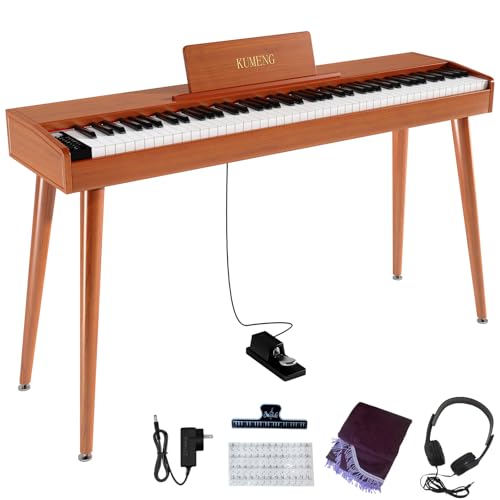
KUMENG 88-Key Semi-Weighted Digital Piano
Best for: beginners developing touch sensitivity
- Number of Keys
- 88
- Key Action
- Semi-weighted
- Preset Tones
- 800
- Pedal Type
- Pedal
- Connectivity
- USB-MIDI
- Target Audience
- Beginners
View on Amazon: KUMENG 88-Key Semi-Weighted Digital Piano Affiliate link
The KUMENG KU-3506 is a full-size 88-key digital piano with semi-weighted action. It offers 800 preset tones and 128 notes of polyphony. The unit includes USB/MIDI connectivity for app pairing and MP3 playback. Its matte finish and woodgrain design suit home decor. This instrument is designed for players developing touch sensitivity.
Pros
- 88 full-size semi-weighted keys for touch development
- 128 polyphony for complex playing
- 800 preset tones for diverse styles
- USB/MIDI connectivity for app integration
Cons
- Semi-weighted action lacks the resistance of fully weighted keys
- No Bluetooth connectivity listed in specifications
- No dedicated display screen for function tracking
Good fit if
- You are a beginner developing finger strength
- You need many tones for varied practice
- You want to connect to learning apps via USB
Skip if
- You require fully weighted hammer action
- You need wireless Bluetooth audio
- You prefer a compact portable size
Verdict: KUMENG KU-3506 88-Key Semi-Weighted Digital Piano provides a spacious keybed and extensive tone library for beginners. It fits learners who prioritize touch development and app connectivity over weighted resistance.
Specifications side by side
| Spec | Alesis Recital 88-Key Digital Piano | KUMENG 88-Key Semi-Weighted Digital Piano |
|---|---|---|
| Number of Keys | 88 | 88 |
| Key Action | Semi-weighted | Semi-weighted |
| Preset Tones | 5 | 800 |
| Pedal Type | 1/4" sustain pedal input | Pedal |
| Connectivity | not stated | USB-MIDI |
| Speaker System | Dual 20W | not stated |
| Target Audience | Beginners | Beginners |
| Color | Black | Brown |
| Special Features | Built-In Speakers | not stated |
| Dimensions | 50 × 12 × 4 inches | 12.2 × 53 × 6.5 inches |
| Weight | 15.7 pounds | not stated |
| Size | Full | Full-Size |
| Model | Recital | KU-3506 Digital Piano with Standf |
Frequently asked questions
Which digital piano is lighter to carry?
The Alesis Recital is the lighter option at 15.7 pounds. This makes it easier to transport for practice sessions or small performances. The KUMENG model is heavier and larger, weighing more due to its included stand. If portability is your main concern, the Alesis is the better choice for moving between locations.
Do both brands offer semi-weighted keys?
Yes, both the Alesis Recital and the KUMENG KU-3506 feature semi-weighted keys. This action type provides a balance between the light touch of an organ and the resistance of an acoustic piano. It is suitable for beginners learning basic technique without the full weight of a graded hammer system.
Which piano has more preset sounds?
The KUMENG digital piano offers a significantly broader palette with 800 preset tones. This extensive library allows you to explore diverse genres and experiment with different timbres. The Alesis Recital focuses on a more essential selection of sounds, prioritizing clarity and standard piano tones over variety.
Is the KUMENG piano better for touch sensitivity practice?
The KUMENG KU-3506 is designed for learners who prioritize touch development. Its spacious keybed and extensive tone library support exercises in dynamic control. The Alesis Recital is a practical starter instrument for those who value portability and basic educational tools over advanced sound libraries or heavy key resistance.
What are the physical dimensions of these pianos?
The Alesis Recital measures 50 inches in length, 12 inches in width, and 4 inches in height. The KUMENG KU-3506 is slightly wider at 53 inches, with a height of 6.5 inches and a length of 12.2 inches. These differences affect how much space each instrument requires in your home.
Which brand includes educational software subscriptions?
The Alesis Recital includes a three-month Skoove subscription and a thirty-day Melodics premium trial. These educational resources help you build technique through interactive lessons. The KUMENG model focuses on app connectivity and a large sound library but does not list included software subscriptions in its specifications.
Can I use split and layer modes on these pianos?
The Alesis Recital supports split and layer modes. These features allow you to divide the keyboard or combine sounds for varied practice routines. The KUMENG KU-3506 is noted for its spacious keybed and extensive tone library, making it suitable for exploring different timbres without needing external software.