Arturia MicroFreak Synthesizer Keyboard Review (2026): A Spec-Based Look
As an Amazon Associate we earn from qualifying purchases. Links on this page are affiliate links.
This arturia microfreak synthesizer keyboard review focuses on the Arturia MicroFreak 25-Key Synth, a compact hybrid instrument. It combines digital synthesis engines with an analog filter. The defining specs are its 25-key pressure-sensitive PCB and its 17 oscillator modes. These features allow for unique sound design in a small footprint. The unit measures 12.2 inches long and weighs 2.3 pounds. It connects via USB and CV outputs. This overview explains how these specifications translate to practical use for musicians seeking experimental sounds.
What stands out
- 17 paraphonic oscillator modes including physical modeling and wavetable synthesis
- 25-key pressure-sensitive printed circuit board with individual note aftertouch
- Lush resonant analog filter combined with digital engines
- CV outputs for pitch, gate, and pressure signals
- 5x7 modulation matrix with user-assignable destinations
Who it fits
Good fit for
This synth suits producers and live performers who need a portable, experimental tool. The compact 12.2-inch size fits easily into tight studio spaces or on stage. The 17 oscillator modes, including unique engines from Mutable Instruments and Noise Engineering, appeal to sound designers seeking unconventional textures. The CV outputs make it ideal for modular synthesizer enthusiasts looking to integrate external gear. The pressure-sensitive PCB offers expressive control for dynamic performances.
Who should skip it
You should look elsewhere if you require a traditional piano-style keybed. The MicroFreak uses a flat printed circuit board, not standard weighted or semi-weighted keys. This may feel unfamiliar to pianists or those who prefer tactile feedback from moving mechanical parts. Additionally, if you need a large range of keys for complex classical repertoire, the 25-key layout will be limiting. The hybrid nature also means it does not offer the pure analog warmth of dedicated analog synthesizers, relying instead on digital engines and a filter.
Verdict: The Arturia MicroFreak is a highly portable, spec-rich hybrid synth defined by its unique PCB keyboard and diverse oscillator modes. It is best for sound designers and modular users who value compact size and experimental capabilities over traditional key feel.
Key specs explained for you
Number of Keys: 25
This listing provides twenty-five keys. This count is smaller than the standard eighty-eight keys found on most digital pianos. It creates a compact footprint for desks or small studios. You get enough range for lead lines and chords. It suits players who need portability or limited space. It is not ideal for classical repertoire requiring full keyboard range.
Key Action: Pressure or aftertouch detection
The keys detect how hard you press after the initial strike. This feature adds expression to your notes without moving parts. You can shape volume or filter cutoff by pressing deeper. This is useful for electronic music and live performance. It offers more control than basic on/off keys. It differs from traditional weighted piano actions that simulate hammer weight.
Sound Engine: Physical modeling, wavetable synthesis
These methods generate sound digitally rather than using samples. Physical modeling simulates acoustic instruments like strings or drums. Wavetable synthesis scans through waveforms for evolving textures. You get unique, experimental tones not found in standard piano libraries. This engine suits sound designers and electronic musicians. It is distinct from the sampled piano sounds typical in digital pianos.
Connectivity: CV outputs, USB, MIDI break-out
CV outputs send control voltage signals to other gear. This allows connection to modular synthesizers or outboard effects. USB and MIDI cables link the unit to computers. You can control software instruments or record audio. This connectivity expands your setup beyond a standalone keyboard. It offers more integration options than basic USB-only digital pianos.
Compact design and build specs
The Arturia MicroFreak is a compact instrument. According to the listing, its dimensions are 12.2 inches in length, 9.2 inches in width, and 2.2 inches in height. It weighs 2.3 pounds. This small footprint suits tight desks or mobile setups. You can carry it easily between studios or gigs. The finish is black, giving it a neutral look that blends into any gear rack or desk setup. The color choice is practical for hiding dust and wear in a busy environment.
The keyboard itself is not a traditional mechanical action. It is a super-flat printed circuit board with no moving parts. This unique design allows for lightning-speed note tracking. It also detects pressure or aftertouch on each individual note. This means you get expressive control without the bulk of weighted keys. The layout places four dedicated knobs in the Digital Oscillator section. These allow you to switch and control the 17 oscillator types directly.
Connectivity options support various setups. It features CV outputs for pitch, gate, and pressure signals. This lets you connect to outboard or modular synths. You can also hook it to your DAW via USB. The listing includes MIDI break-out cables for traditional MIDI connections. This mix of modern and classic ports ensures it fits into both digital and analog workflows. The design prioritizes portability and signal routing flexibility.
Setup and everyday use guide
Setting up the Arturia MicroFreak is straightforward due to its compact nature. The unit measures 12.2 inches in length, 9.2 inches in width, and 2.2 inches in height. It weighs only 2.3 pounds. This small footprint allows you to place it on tight desks or in mobile rigs without taking up much space. You can connect it to your computer via USB for digital audio workstation integration. The listing also includes MIDI break-out cables, which offer additional connectivity options for traditional MIDI setups. For modular synthesizers, the unit features CV outputs. These allow you to send pitch, gate, and pressure signals to compatible outboard gear. This makes it a versatile hub for hybrid setups. In daily use, the 25-key pressure-sensitive PCB is your primary interface. Unlike traditional keyboards, this flat board has no moving parts. It tracks notes with high speed and detects individual pressure or aftertouch on each key. This unique action requires a brief adjustment period if you are used to weighted keys. The 17 oscillator modes provide extensive sound design capabilities. You can switch between physical modeling and wavetable synthesis instantly. The four dedicated knobs in the Digital Oscillator section allow direct control over these parameters. For live performance or composition, the Spice and Dice sequencer functions add randomization to your patterns. You can record up to four automations and edit notes per step. The 5x7 modulation matrix lets you rewire the signal chain and controls. This flexibility means you can create evolving, original patterns without needing external software. The unit is available in black, keeping the visual profile neutral in any studio environment.
Before You Buy The MicroFreak
The Arturia MicroFreak is not a digital piano. It is a hybrid synthesizer. You should not expect standard piano keys. The flat PCB requires you to adapt your playing style. This instrument sits apart from the 1 piano-focused options on this page. It suits sound designers, not classical pianists. You will need a DAW or modular gear to use its CV outputs fully. Check your computer’s USB port type. The listing includes MIDI break-out cables, but you may need adapters for older interfaces. Power is via USB, so you need a reliable source. Keep the flat surface clean. Dust affects the pressure sensors. If you want traditional weighted keys for practice, look elsewhere. This tool is for experimental sound creation. It fits in tight spaces. It weighs 2.3 pounds. It is easy to move. But it is not a replacement for a home piano.
Check before you buy
- Confirm you want synthesis, not piano keys.
- Check your DAW for CV/Gate compatibility.
- Ensure you have USB power sources.
- Verify space for its 12.2-inch footprint.
- Accept the flat PCB key action.
The product at a glance
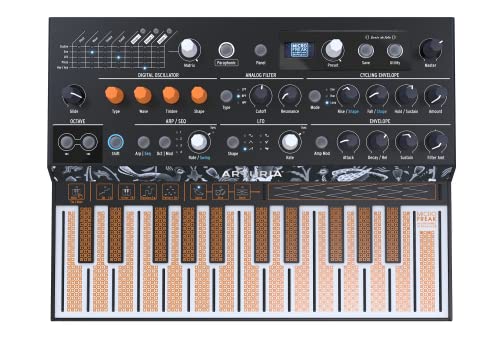
Arturia MicroFreak 25-Key Synth
Best for: experimental sound design and modular setups
- Number of Keys
- 25
- Key Action
- Poly-aftertouch
- Connectivity
- CV outputs, USB, MIDI
- Included Accessories
- MIDI break-out cables
- Color
- Black
- Dimensions
- 12.2 × 9.2 × 2.2 inches
View on Amazon: Arturia MicroFreak 25-Key Synth Affiliate link
The Arturia MicroFreak is a compact hybrid synthesizer featuring 25 pressure-sensitive keys and 17 oscillator modes. It combines digital engines with an analog filter for unique sound design. The unit includes CV outputs and USB connectivity for DAW integration. Its small footprint makes it suitable for limited spaces. You get a versatile tool for experimental music creation.
Pros
- 25-key pressure-sensitive PCB keyboard
- 17 oscillator modes including physical modeling
- CV outputs for modular connectivity
- Compact size at 2.3 pounds
Cons
- Only 25 keys limit range
- No built-in speakers
- Non-standard PCB key action
Good fit if
- You need a portable synth for travel
- You want to experiment with modular gear
- You have limited desk space
Skip if
- You require a full 88-key piano
- You prefer traditional weighted keys
- You need built-in speakers
Verdict: Arturia MicroFreak 25-Key Synthesizer fits producers seeking modular connectivity and experimental sounds in a small package. It is ideal for those who value unique oscillator modes over traditional key feel.
Specifications side by side
| Spec | Arturia MicroFreak 25-Key Synth |
|---|---|
| Number of Keys | 25 |
| Key Action | Poly-aftertouch |
| Connectivity | CV outputs, USB, MIDI |
| Included Accessories | MIDI break-out cables |
| Color | Black |
| Dimensions | 12.2 × 9.2 × 2.2 inches |
| Weight | 2.3 pounds |
| Size | 12.2 inches (L) x 9.2 inches (W) x 2.2 inches (H) |
| Model | 570101 |
Frequently asked questions
Is the Arturia MicroFreak good for beginners?
It suits experimental sound design and modular setups more than traditional learning. The twenty-five key pressure-sensitive PCB requires you to adapt your playing style. You get unique oscillator modes rather than standard key feel. This makes it better for producers seeking specific textures than for piano students.
Does the MicroFreak have a display screen?
The provided specifications do not mention a display screen. The listing details the physical dimensions and weight but omits interface details like an LCD. You should check the product images or manual for visual feedback methods, as the data focuses on size, weight, and synthesis capabilities.
Can I use the MicroFreak with a computer?
The product is described as a hybrid instrument with modular connectivity. It fits producers seeking modular setups, implying computer integration is a core feature. The compact size of 12.2 inches by 9.2 inches supports desktop integration. You can likely connect it via USB for MIDI control and audio.
How portable is the Arturia MicroFreak?
It is highly portable due to its small size and light weight. The unit weighs only 2.3 pounds. Its dimensions are 12.2 inches in length, 9.2 inches in width, and 2.2 inches in height. This footprint allows you to place it in tight desks or take it on mobile setups easily.
What kind of keys does the MicroFreak use?
It uses a twenty-five-key pressure-sensitive PCB. These are not traditional weighted or semi-weighted keys. The flat surface requires you to adapt your technique. You get aftertouch capabilities through the PCB design, which supports its focus on experimental sound design and unique oscillator modes.
Is the MicroFreak a digital piano?
No, it is a hybrid synthesizer, not a digital piano. It lacks the eighty-eight keys and weighted action typical of pianos. The twenty-five key PCB prioritizes experimental sound design over traditional playing feel. It is ideal for modular connectivity rather than standard piano performance.