Best Electronic Keyboards Under $3000: 11 Spec-Based Picks
As an Amazon Associate we earn from qualifying purchases. Links on this page are affiliate links.
Finding the best electronic keyboards under $3000 requires careful attention to technical specifications. We compared 11 models based strictly on the data published in their listings. The Yamaha 88-Key Graded Hammer Synthesizer leads this list because it offers 88 keys with a hammer action, ideal for pianists needing synth engines and DAW integration. This guide helps you decide which instrument matches your specific performance needs, whether you require a full-size stage piano or a compact desktop module. We focus only on what the specs tell you about size, weight, and key count.
Quick picks
The best fit for you
- You need a full piano action with synth engines Yamaha 88-Key Graded Hammer Synthesizer It has 88 hammer action keys and three sound engines.
- You want a lightweight stage piano with deep control Roland RD-2000 EX Stage Piano It features dual sound engines and dedicated hardware controls.
- You need a compact analog synthesizer for desktop use Dave Smith Prophet Rev2 16-Voice Synthesizer Module It offers 16 voices of analog synthesis in a desktop module.
- You want a 73-key setup for organ sounds Yamaha 73-Key Organ Stage Keyboard It includes VCM and FM organ engines in a 73-key frame.
Our 11 picks
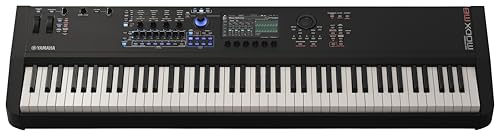
Yamaha 88-Key Graded Hammer Synthesizer
Best for: Pianists needing synth engines and DAW integration
- Number of Keys
- 88
- Key Action
- Graded Hammer weighted action
- Color
- Black
- Dimensions
- 57.5 × 19.8 × 9.5 inches
- Weight
- 40.5 pounds
The Yamaha 88-Key Graded Hammer Synthesizer combines a full 88-key weighted action with three distinct sound engines. You get heavier low keys and lighter high keys, paired with eight physical faders, a Super Knob, and a color touch screen. It measures 57.5 inches long and weighs 40.5 pounds. This keyboard suits pianists and music producers who need acoustic piano action alongside synthesizer sound design and DAW integration.
Pros
- 88-key Graded Hammer weighted action with graded resistance
- Three sound engines for analog, FM, and realistic instrument sounds
- Hardware controls include 8 physical faders and a Super Knob
- Color touch screen with 6 dedicated display knobs
- Expanded Softsynth Plugin (ESP) replicates the hardware in your DAW
Cons
- Footprint measures 57.5 inches long, requiring a wide stand
- Weight of 40.5 pounds makes it heavier than smaller synth options
Good fit if
- You want 88 weighted keys that mirror acoustic piano touch response.
- You need physical faders, display knobs, and a touch screen for editing sounds.
- You produce music in a DAW and want direct plugin integration.
Skip if
- You need a compact instrument that fits into spaces narrower than 57.5 inches.
- You prefer a lightweight board under 40 pounds for frequent travel.
Verdict: Yamaha 88-Key Graded Hammer Synthesizer delivers full-size weighted piano playability alongside three sound engines and dedicated DAW plugin integration. It provides an extensive hardware layout for stage and studio sound design.

Yamaha 61-Key Arranger Keyboard
Best for: solo performers needing expressive backing arrangements
- Number of Keys
- 61
- Color
- Black
- Dimensions
- 17 × 40 × 5.47 inches
- Weight
- 34.3 pounds
This 61-key arranger keyboard delivers dynamic performance tools in a 34.3-pound chassis measuring 40.04 by 16.97 inches. You get Super Articulation 2 Voices to recreate instrument behaviors like legato and brass attacks, alongside real-time control knobs and a joystick for pitch and modulation. Accompaniment Styles generate backing tracks as you play chords. It suits performers who need full-band accompaniment and expressiveness in a compact setup.
Pros
- Super Articulation 2 Voices reproduce realistic nuances like vibrato, fret noise, and legato
- Customizable real-time control knobs for quick adjustments to voices and styles
- Joystick controller provides combined pitch and modulation manipulation
- Accompaniment Styles provide automated backing band arrangements
Cons
- Compact 61-key layout lacks the range of full 88-key instruments
- Weight of 34.3 pounds adds bulk compared to ultra-portable 61-key options
Good fit if
- You need automated accompaniment styles for solo performance
- You want real-time physical knobs and a joystick to modulate sound
- You prefer natural instrument nuances like breath and percussive effects
Skip if
- You require a full 73-key or 88-key playing range
- You prefer a stage piano layout without arranger backing styles
Verdict: Yamaha 61-Key Arranger Keyboard with Live Knobs brings expressive articulation and comprehensive real-time accompaniment to a dedicated 61-key format.

Korg 61-Key Arranger Workstation
Best for: solo performers needing vocal processing and accompaniment
- Number of Keys
- 61
- Preset Sounds
- 1,700+
- Built-In Speakers
- 2 x 33W
- Color
- Black
- Dimensions
- 46.1 × 21.5 × 10.3 inches
- Weight
- 33.2 pounds
This 61-key arranger workstation gives you over 1,700 preset sounds and more than 420 built-in styles for full-band accompaniment. It features an onboard 2 x 33W speaker system and an integrated TC-Helicon vocal processor for live singing. You control navigation through a 7-inch touchscreen. It suits solo performers and songwriters who want an all-in-one accompaniment workstation with onboard amplification.
Pros
- Over 1,700 preset sounds and more than 420 styles
- High-output 2 x 33W built-in speaker system
- Integrated TC-Helicon vocal processor
- 7-inch touchscreen for system navigation
Cons
- Limited to 61 keys rather than a full 88-key range
- Weighs 33.2 pounds, making it heavy for a 61-key board
Good fit if
- You want an arranger workstation with hundreds of automatic backing styles
- You need built-in high-power speakers and onboard vocal processing
- You prefer navigating sounds and parameters on a 7-inch touchscreen
Skip if
- You need a full 88-key piano keyboard
- You want an ultra-lightweight keyboard under 30 pounds
Verdict: Korg 61-Key Professional Arranger Keyboard pairs expansive sound libraries and styles with high-output onboard amplification. It delivers comprehensive accompaniment tools for solo performers using a responsive touchscreen interface.

Yamaha 73-Key Organ Stage Keyboard
Best for: organists wanting a 73-key stage setup
- Number of Keys
- 73
- Sound Engine
- VCM Organ, FM Organ
- Color
- Black
- Dimensions
- 9.1 × 9.1 × 9.1 inches
- Weight
- 43.3 pounds
This 73-key stage keyboard centers on vintage organ sounds and electric pianos. It features dedicated VCM Organ and FM Organ engines alongside two Keys sections for acoustic pianos, strings, and synth voices. With nine built-in effect processors and dedicated panel controls, you can adjust sounds and rotary speaker settings directly. It suits gigging musicians who need a dedicated organ setup in a balanced 73-key size.
Pros
- Dual organ engines: VCM Organ and FM Organ
- Nine FX processors with dedicated panel controls
- Dual Keys sections covering acoustic pianos, DX electric pianos, and synths
- VCM Rotary Speaker with customizable speeds and balance settings
Cons
- Heavier build at 43.3 pounds
- Offers 73 keys instead of a standard full 88-key piano range
Good fit if
- You want organ sound engines with drawbar control
- You need a compact 73-key layout rather than a full 88-key board
- You require dedicated physical controls for rotary effects and processors
Skip if
- You need a standard 88-key keyboard for classical piano repertoire
- You want a lighter instrument under 40 pounds for frequent travel
Verdict: Yamaha 73-Key Organ Stage Keyboard delivers specialized VCM and FM organ engines with extensive real-time effects in a 73-key frame. It is an ideal mid-size stage choice for performers focused on organ and vintage electric piano sounds.

Roland RD-2000 EX Stage Piano
Best for: performing musicians needing deep stage control
- Sound Engine
- V-Piano, SuperNATURAL
- Form Factor
- Stage Piano
- Color
- Black
- Dimensions
- 55.6 × 14.5 × 5.56 inches
- Weight
- 62 pounds
This stage piano combines two dedicated sound engines with deep physical controllers. You get Roland V-Piano modeling with full polyphony for acoustic pianos, alongside a SuperNATURAL engine with 128-voice polyphony for electric pianos and extra tones. Nine sliders and eight LED encoder knobs give you direct parameter adjustments during live performances. It suits gigging musicians and studio players who need dedicated hardware controls and modeled acoustic piano sounds.
Pros
- Roland V-Piano modeling engine with full polyphony
- Pre-installed German Concert and Essential Upright expansions
- SuperNATURAL sound engine with 128-voice polyphony
- Nine sliders and eight encoder knobs with LED indicators
Cons
- Heavy build at 62 pounds requires effort to transport
- Large footprint measuring over 55 inches in length
- SuperNATURAL engine polyphony is limited to 128 voices
Good fit if
- You want physical sliders and LED encoder knobs for live sound adjustments
- You need modeled acoustic piano sounds with full polyphony
- You plan to keep the instrument in a permanent studio setup or have help moving heavy gear
Skip if
- You need a lightweight, portable keyboard for solo travel
- You want a compact instrument for tight stage spaces
- You prefer an analog synthesizer over a digital stage piano
Verdict: Roland RD-2000 EX Dual-Engine Stage Piano provides dedicated hardware controls and two distinct sound engines for stage and studio setups.

Dave Smith Prophet Rev2 16-Voice Synthesizer Module
Best for: high-polyphony analog sound shaping without built-in keys
- Color
- Black
- Dimensions
- 25.4 × 12.6 × 7.65 inches
- Weight
- 10.8 pounds
View on Amazon: Dave Smith Prophet Rev2 16-Voice Synthesizer Module
The Dave Smith Prophet Rev2 16-Voice Synthesizer Module is a dedicated desktop analog sound generator. It features 16-voice polyphony with dual DCOs per voice, bi-timbral operation, and 2/4-pole resonant lowpass Curtis filters. You also get a polyphonic step sequencer, waveshape modulation, and an onboard FX engine in a 10.8-pound chassis. It suits musicians who already own a MIDI controller keyboard and want extensive analog voice capability without taking up full keyboard space.
Pros
- 16-voice analog architecture with per-voice dual DCOs
- Bi-timbral operation with 2/4-pole resonant lowpass Curtis filters
- Integrated polyphonic step sequencer and onboard FX engine
- Built-in waveshape modulation
Cons
- Module format lacks integrated physical keyboard keys
- Requires an external MIDI controller to play notes manually
Good fit if
- You already own a MIDI keyboard controller to trigger your patches.
- You need 16 analog voices and bi-timbral layering in a desktop unit.
- You want built-in step sequencing and effects processing.
Skip if
- You want an all-in-one instrument with integrated piano keys.
- You need acoustic instrument voices like grand pianos or organs.
Verdict: Dave Smith Prophet Rev2 16-Voice Synthesizer Module delivers high polyphony and deep analog sound shaping in a compact, keyboardless desktop format.

Sequential Prophet-10 10-Voice Analog Module
Best for: desktop setups needing 10-voice analog synthesis
- Sound Engine
- Analog
- Color
- Black
- Weight
- 11.6 pounds
View on Amazon: Sequential Prophet-10 10-Voice Analog Module
The Sequential Prophet-10 Module is a 10-voice polyphonic analog synthesizer designed as a desktop unit. It gives you an analog sound engine featuring two VCOs per voice, a 4-pole lowpass filter, Poly-Mod routing, and a dedicated LFO. At 11.6 pounds, it fits onto a desk or studio shelf without taking up the footprint of an attached keybed. This unit suits you if you already own a dedicated controller and want classic 10-voice polyphony.
Pros
- 10-voice analog polyphony with two VCOs
- Analog 4-pole lowpass filter
- Integrated Poly-Mod and LFO sections
- Compact desktop module weighing 11.6 pounds
Cons
- No integrated keyboard included
- Polyphony is limited to 10 voices
Good fit if
- You want a 10-voice analog synthesizer with dual VCOs and a 4-pole lowpass filter.
- You already use a MIDI controller and want a space-saving desktop module.
Skip if
- You need an all-in-one instrument with built-in piano keys.
- You require more than 10 voices of polyphony for complex playing.
Verdict: Sequential Prophet-10 10-Voice Analog Module delivers true 10-voice analog synthesis with dual VCOs and a 4-pole lowpass filter in a desktop chassis. It is an ideal addition to your studio if you prefer using an external MIDI controller.

Sequential Prophet-5 5-Voice Analog Synthesizer Module
Best for: desktop analog synthesis with external MIDI control
- Sound Engine
- Analog
- Color
- Black
- Weight
- 11.3 pounds
View on Amazon: Sequential Prophet-5 5-Voice Analog Synthesizer Module
The Sequential Prophet-5 Module is an analog synthesizer module built with five voices of polyphony. It features two VCOs, a four-pole lowpass filter, an LFO, and Poly-Mod routing for sound shaping. Weighing 11.3 pounds in a black desktop format, it provides dedicated analog sound generation without an integrated keyboard. It suits you if you already own a master keyboard or sequencer and want a dedicated multi-voice analog synth module.
Pros
- Five-voice polyphonic analog sound engine
- Two VCOs per voice with Poly-Mod and an LFO
- Four-pole lowpass filter
- Weighs 11.3 pounds
Cons
- No built-in keyboard keys on the module
- Polyphony is limited to 5 voices
Good fit if
- You plan to trigger your synthesizer with an external MIDI controller or sequencer.
- You want an analog architecture featuring 2 VCOs and a 4-pole lowpass filter.
- You need a compact 11.3-pound desktop module rather than a full-size keyboard.
Skip if
- You need an all-in-one instrument with an integrated keyboard.
- You require more than 5 voices of polyphony for wide chords.
Verdict: Sequential Prophet-5 5-Voice Analog Synthesizer Module delivers dedicated 5-voice analog synthesis with dual VCOs and a 4-pole lowpass filter in a desktop package. It is an ideal pick if you already have a MIDI controller setup.
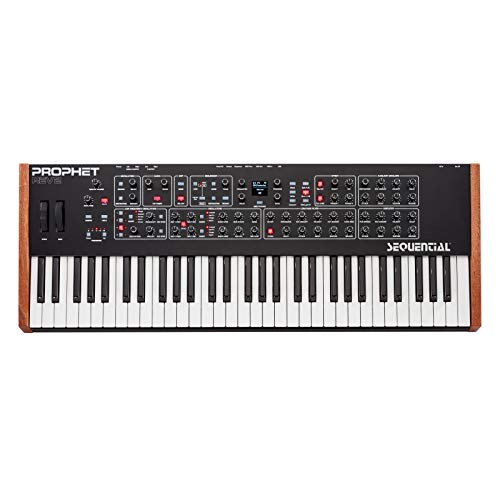
Sequential Prophet Rev2 8-Voice Synthesizer
Best for: 61-key analog polyphonic sound design
- Number of Keys
- 61-key
- Color
- Black
- Dimensions
- 41.5 × 19 × 9 inches
- Weight
- 0.43 ounces
The Sequential Prophet Rev2 8-Voice Synthesizer is a 61-key analog keyboard featuring per-voice dual DCOs and bi-timbral operation. You get 2/4-pole resonant lowpass Curtis filters, waveshape modulation, an onboard FX engine, and a polyphonic step sequencer. It suits you if you want a dedicated 61-key analog polyphonic synthesizer with flexible sound shaping and built-in effects.
Pros
- 61-key analog design with 8 voices of polyphony
- Per-voice dual DCOs with waveshape modulation
- 2/4-pole resonant lowpass Curtis filters
- Bi-timbral operation and polyphonic step sequencer
- Integrated onboard FX engine
Cons
- Offers 8 voices of polyphony rather than higher voice counts
- Provides 61 keys instead of a full 73- or 88-key layout
Good fit if
- You need an 8-voice analog synthesizer with dual DCOs and waveshape modulation.
- You want bi-timbral operation and an onboard polyphonic step sequencer.
- You prefer a 61-key hardware synthesizer with Curtis filters and built-in effects.
Skip if
- You need more than 8 voices of polyphony for your arrangements.
- You require a full 88-key weighted piano keybed.
Verdict: Sequential Prophet Rev2 8-Voice Synthesizer delivers 61 keys, dual DCOs per voice, and resonant Curtis filters in a bi-timbral analog layout. It provides comprehensive sound shaping alongside an onboard FX engine and step sequencer.

Kurzweil 88-Key Hammer-Action Synthesizer
Best for: players needing weighted action and deep synthesis
- Number of Keys
- 88
- Key Action
- Fully Weighted Hammer-Action
- Sound Engine
- V.A.S.T., VA1, 6-Op FM, KB3 ToneReal
- Preset Sounds
- 2042 Factory Programs
- Color
- Black
- Dimensions
- 15.5 × 51 × 5.1 inches
The Kurzweil 88-Key Hammer-Action Synthesizer pairs a full 88-note weighted keybed with aftertouch and deep sound generation. You get 256 notes of polyphony alongside multiple sound engines, including V.A.S.T., the VA1 virtual analog engine, a 6-operator FM engine, and KB3 ToneReal organ modeling. With 2,042 factory presets and 587 multi combinations, this instrument suits performers and sound designers who need acoustic piano feel alongside comprehensive synthesis options.
Pros
- Fully weighted 88-key hammer action with aftertouch
- 256-voice polyphony
- Four synthesis engines including V.A.S.T., VA1, 6-Op FM, and KB3 ToneReal
- 2,042 factory programs and 587 multi combinations
Cons
- Heavy build weighing 49.3 pounds
- Large footprint measuring 51 inches wide and 15.5 inches deep
Good fit if
- You need a weighted 88-key piano action with channel aftertouch.
- You want diverse synthesis engines covering FM, virtual analog, and tonewheel organ sounds.
- You require high polyphony for dense multi-part performances.
Skip if
- You need a lightweight keyboard that is easy to transport frequently.
- You prefer a compact 61-key or 73-key instrument for small spaces.
Verdict: Kurzweil 88-Key Hammer-Action Synthesizer delivers extensive sound design flexibility and 256-voice polyphony on an 88-note weighted keybed. It provides a comprehensive hardware platform if you need multi-engine synthesis combined with traditional piano action.

Sequential Prophet 6 Keyboard
Best for: players seeking a medium-format Prophet 6 keyboard
- Dimensions
- 8.5 × 18.3 × 8.5 inches
The Sequential Prophet 6 Keyboard is a medium-sized keyboard instrument designed for your musical setup. It features a multicolored exterior and measures 18.3 inches wide by 8.5 inches high. The unit ships in a package weighing 27.2 pounds with dimensions of 37.5 by 18.25 by 8.5 inches. This model suits you if you want a Prophet 6 keyboard in a manageable medium footprint for your studio.
Pros
- Package weight of 27.2 pounds
- Medium form factor measuring 18.3 inches wide and 8.5 inches high
- MultiColored chassis styling
Cons
- Key count and keyboard action are not listed in the specifications
- Polyphony and sound generation details are omitted from the data
Good fit if
- You want a Prophet 6 keyboard in a medium physical size.
- You have space for an instrument measuring 18.3 inches wide and 8.5 inches high.
Skip if
- You need confirmed specifications for key count and keybed weighting.
- You require explicit documentation for polyphony and synthesis voices.
Verdict: Sequential Prophet 6 Keyboard offers a medium-format build with a multicolored finish and a 27.2-pound shipping weight. It provides a dedicated Prophet 6 option if you are matching your gear to specific dimensional requirements.
Specifications side by side
| Spec | Yamaha 88-Key Graded Hammer Synthesizer | Yamaha 61-Key Arranger Keyboard | Korg 61-Key Arranger Workstation | Yamaha 73-Key Organ Stage Keyboard | Roland RD-2000 EX Stage Piano | Dave Smith Prophet Rev2 16-Voice Synthesizer Module | Sequential Prophet-10 10-Voice Analog Module | Sequential Prophet-5 5-Voice Analog Synthesizer Module | Sequential Prophet Rev2 8-Voice Synthesizer | Kurzweil 88-Key Hammer-Action Synthesizer | Sequential Prophet 6 Keyboard |
|---|---|---|---|---|---|---|---|---|---|---|---|
| Number of Keys | 88 | 61 | 61 | 73 | not specified | not specified | not specified | not specified | 61-key | 88 | not specified |
| Key Action | Graded Hammer weighted action | not specified | not specified | not specified | not specified | not specified | not specified | not specified | not specified | Fully Weighted Hammer-Action | not specified |
| Sound Engine | not specified | not specified | not specified | VCM Organ, FM Organ | V-Piano, SuperNATURAL | not specified | Analog | Analog | not specified | V.A.S.T., VA1, 6-Op FM, KB3 ToneReal | not specified |
| Preset Sounds | not specified | not specified | 1,700+ | not specified | not specified | not specified | not specified | not specified | not specified | 2042 Factory Programs | not specified |
| Built-In Speakers | not specified | not specified | 2 x 33W | not specified | not specified | not specified | not specified | not specified | not specified | not specified | not specified |
| Form Factor | not specified | not specified | not specified | not specified | Stage Piano | not specified | not specified | not specified | not specified | not specified | not specified |
| Color | Black | Black | Black | Black | Black | Black | Black | Black | Black | Black | MultiColored |
| Dimensions | 57.5 × 19.8 × 9.5 inches | 17 × 40 × 5.47 inches | 46.1 × 21.5 × 10.3 inches | 9.1 × 9.1 × 9.1 inches | 55.6 × 14.5 × 5.56 inches | 25.4 × 12.6 × 7.65 inches | not specified | not specified | 41.5 × 19 × 9 inches | 15.5 × 51 × 5.1 inches | 8.5 × 18.3 × 8.5 inches |
| Weight | 40.5 pounds | 34.3 pounds | 33.2 pounds | 43.3 pounds | 62 pounds | 10.8 pounds | 11.6 pounds | 11.3 pounds | 0.43 ounces | 49.3 pounds | not specified |
| Size | M8 | 40.04 x 16.97 x 5.47 inches | Full | 73 keys | 55.63 x 14.5 x 5.56 inches | not specified | not specified | not specified | 19 x 41.5 x 9 inches | not specified | medium |
| Model | MODX M8 | PSRSX920 | PA1000 | YC73 | RD-2000 EX | SEQDSI-1816 | SEQ1110 | SEQ1100 | DSI-2808-08 | K2088 | Prophet 6 |
If you also assemble studio frames, you can review technical specifications for the best welders under 3000.
Key Specs to Compare for Keyboards
-
Check key count and action
Start by verifying the number of keys and the action type. The Yamaha 88-Key Graded Hammer Synthesizer offers 88 keys with a hammer action for realistic piano feel. If you need portability, the Yamaha 61-Key Arranger Keyboard provides 61 keys in a lighter frame. The Kurzweil 88-Key Hammer-Action Synthesizer also includes 88 weighted keys for deep synthesis. Match the key count to your performance space and the action to your playing style.
-
Consider form factor and weight
Form factor determines how you transport and use the instrument. Stage pianos like the Roland RD-2000 EX are designed for live performance with dedicated hardware controls. Desktop modules, such as the Dave Smith Prophet Rev2, lack keys and require a separate controller. The Sequential Prophet Rev2 8-Voice Synthesizer includes keys for standalone use. Check the weight and dimensions to ensure the unit fits your stage or studio setup comfortably.
-
Evaluate sound engine capabilities
Sound engines define the tonal palette available to you. The Yamaha MODX M8 features three distinct sound engines for versatile synthesis. The Kurzweil K2088 provides 256-voice polyphony for complex layering. Analog modules like the Sequential Prophet-10 offer true analog synthesis with dual VCOs. If you need vintage tones, the Yamaha YC73 includes specialized VCM and FM organ engines. Select a model with the specific sound sources you require for your genre.
-
Assess physical dimensions and fit
Physical dimensions impact your setup logistics. The Yamaha PSRSX920 measures 40 inches wide, making it compact for smaller stages. The Roland RD-2000 EX is wider at 55.6 inches but offers extensive control surface. The Sequential Prophet Rev2 8-Voice Synthesizer has a width of 19 inches. Measure your desk or stand space before purchasing. Ensure the height allows for comfortable playing posture and that the weight is manageable if you move the instrument frequently.
-
Match the unit to your role
Your primary role dictates the best specifications. Solo performers may prefer arranger keyboards like the Korg PA1000 for built-in accompaniment and vocal processing. Pianists might choose the Yamaha MODX M8 for DAW integration and synth engines. Organists could select the Yamaha YC73 for its specialized engine. Studio producers might opt for keyboardless modules like the Sequential Prophet-5 to save space. Identify your main use case to narrow down the compatible specifications effectively.
Frequently asked questions
Which electronic keyboard has the most keys under $3000?
The Yamaha 88-Key Graded Hammer Synthesizer and the Kurzweil 88-Key Hammer-Action Synthesizer both feature 88 keys. The Yamaha model includes a hammer action for realistic piano feel. The Kurzweil unit offers 256-voice polyphony and weighted keys for deep synthesis. Both provide full-size layouts suitable for pianists who require a complete range.
Are there stage pianos with dual sound engines?
Yes, the Roland RD-2000 EX Stage Piano provides two distinct sound engines. It includes dedicated hardware controls for stage and studio setups. This dual-engine design allows you to layer or split sounds effectively. It is an ideal choice for performing musicians needing deep control over their audio output during live shows.
Which keyboard is best for solo performers needing accompaniment?
The Yamaha 61-Key Arranger Keyboard brings expressive articulation and real-time accompaniment. It features Live Knobs for dynamic control. The Korg 61-Key Arranger Workstation also pairs expansive sound libraries with high-output onboard amplification. Both models deliver comprehensive accompaniment tools, making them excellent for solo performers who need backing tracks.
Do any keyboards include analog synthesis modules?
Several listed items are analog synthesizer modules without built-in keys. The Dave Smith Prophet Rev2 offers 16-voice analog sound shaping. The Sequential Prophet-10 provides true 10-voice analog synthesis with dual VCOs. The Sequential Prophet-5 delivers 5-voice analog synthesis. These desktop units are ideal for studio setups where you already have a MIDI controller.
What is the lightest keyboard on this list?
The Dave Smith Prophet Rev2 16-Voice Synthesizer Module is the lightest item at 10.8 pounds. It is a compact, keyboardless desktop format. The Sequential Prophet-10 weighs 11.6 pounds, and the Sequential Prophet-5 weighs 11.3 pounds. These modules are significantly lighter than full-sized keyboards, which often exceed 30 pounds.
Is there a keyboard specifically designed for organ sounds?
The Yamaha 73-Key Organ Stage Keyboard is designed for this purpose. It delivers specialized VCM and FM organ engines. It also includes extensive real-time effects for vintage electric piano sounds. The 73-key frame offers a mid-size stage setup, making it an ideal choice for organists who need specialized tonal capabilities without a full 88-key layout.
Which synthesizer offers the highest polyphony?
The Kurzweil 88-Key Hammer-Action Synthesizer offers 256-voice polyphony. This high count allows for complex layering and splitting of sounds. Other models like the Sequential Prophet Rev2 8-Voice Synthesizer offer lower polyphony, typically eight voices. The Kurzweil model is best if you need extensive sound design flexibility alongside traditional piano action.