MOOG Electronic Keyboards: 4 Picks Ranked by Specs
As an Amazon Associate we earn from qualifying purchases. Links on this page are affiliate links.
This guide ranks the best MOOG electronic keyboards by comparing their published specifications. You will find a range of instruments here, from compact 32-key analog units to larger studio workstations and unique gesture-based controllers. The top pick is the MOOG Theremini Synthesizer, which leads for its distinct approach to gesture-based analog sound exploration. We compared 4 models in this list. Each selection is based strictly on the technical data provided in the product listings, such as weight, dimensions, and key count. This approach helps you identify the hardware that fits your specific workflow needs.
Quick picks
| # | Product | Best for | Price |
|---|---|---|---|
| 1 | MOOG Theremini Synthesizer Best overall | gestural synthesis and guided pitch control | Check price of MOOG Theremini Synthesizer on Amazon |
| 2 | Moog Grandmother 32-Key Analog Synthesizer Best budget | analog sound design and modular patching | Check price of Moog Grandmother 32-Key Analog Synthesizer on Amazon |
| 3 | MOOG Muse 8-Voice Analog Synthesizer Best premium | Analog sound design and studio production | Check price of MOOG Muse 8-Voice Analog Synthesizer on Amazon |
| 4 | Moog Subsequent 37 Analog Synthesizer Also great | monophonic and duophonic analog sound design | Check price of Moog Subsequent 37 Analog Synthesizer on Amazon |
Our 4 picks

MOOG Theremini Synthesizer
Best for: gestural synthesis and guided pitch control
- Sound Engine
- AniMOOG Synthesizer Sound Engine
- Preset Sounds
- 32 presets
- Built-In Speakers
- Compact speaker
- Connectivity
- Mini USB, pitch CV out, audio outs
- Color
- White
- Special Features
- LCD Screen
View on Amazon: MOOG Theremini Synthesizer Affiliate link
The MOOG Theremini is a gestural synthesizer weighing 2.56 pounds. You operate it using gestural control assisted by adjustable pitch correction and a real-time LCD tuner. It features 32 wavetable-based presets, a built-in compact speaker, stereo line outputs, Pitch CV output, and mini USB MIDI. It suits you if you want motion-based synthesis with built-in audio monitoring.
Pros
- Adjustable assistive pitch correction
- Built-in tuner with LCD visual feedback
- 32 wave- or wavetable-based presets
- Pitch CV output with selectable range
- Built-in compact speaker and headphone jack
Cons
- No physical piano keyboard keys
- Limited to 32 onboard sound presets
- Mini USB port rather than modern USB-C
Good fit if
- You want gestural performance control instead of traditional keys.
- You need pitch correction assistance and visual LCD tuner feedback.
- You want a lightweight 2.56-pound unit with an internal speaker.
Skip if
- You require physical piano keys for traditional keyboard playing.
- You need more than 32 onboard sound presets.
Verdict: MOOG Theremini Gesture Synthesizer suits electronic musicians who want hands-free gestural control and visual pitch training instead of a conventional keybed.

Moog Grandmother 32-Key Analog Synthesizer
Best for: analog sound design and modular patching
- Number of Keys
- 32
- Key Action
- Velocity-sensitive
- Connectivity
- 1/4" in/out, 5-pin DIN MIDI, USB MIDI
- Color
- Black
- Special Features
- Sequencer
- Dimensions
- 14.3 × 23 × 5.51 inches
View on Amazon: Moog Grandmother 32-Key Analog Synthesizer Affiliate link
The MOOG Grandmother is a monophonic semi-modular analog keyboard synthesizer designed for hardware sound design. You get 32 velocity-sensing full-size keys, 41 modular patch points, and an integrated analog spring reverb tank. It includes a built-in 256-note sequencer and arpeggiator. This unit suits you if you want analog synthesis and modular patching without requiring cables to play.
Pros
- Built-in hardware spring reverb tank that processes internal and external sounds
- 41 modular patch points compatible with Eurorack systems
- Integrated 256-note sequencer with storage for three sequence files
- Full-size 32-key velocity-sensing keybed
Cons
- Monophonic architecture limits playback to one note at a time
- 32-key keyboard offers a limited playing range compared to larger synthesizers
- Weighs 16 pounds in a 23-inch wide chassis
Good fit if
- You want a semi-modular analog synth that works with Eurorack gear.
- You need an integrated 256-note sequencer and hardware spring reverb.
Skip if
- You need polyphony to play chords simultaneously.
- You require more than 32 keys for two-handed piano playing.
Verdict: MOOG Grandmother Semi-Modular Synthesizer delivers analog tone generation and modular patch routing on a 32-key layout for musicians seeking hardware patching flexibility.
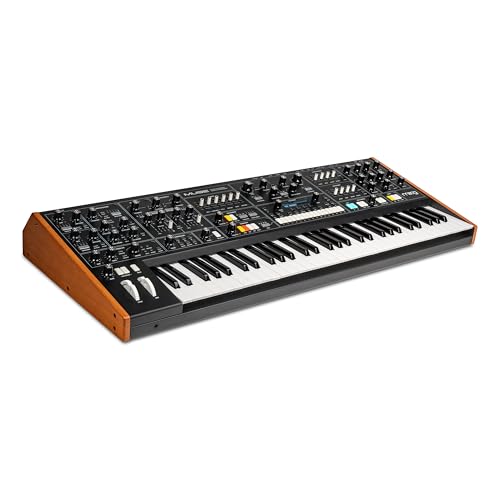
MOOG Muse 8-Voice Analog Synthesizer
Best for: Analog sound design and studio production
- Number of Keys
- 61
- Sound Engine
- 8-voice analog polyphonic
- Preset Sounds
- 256 patches
- Included Accessories
- IEC Cable, Quick Start Guide
- Color
- Black
- Special Features
- Sequencer
View on Amazon: MOOG Muse 8-Voice Analog Synthesizer Affiliate link
The MOOG Muse is an 8-voice analog polyphonic synthesizer designed for studio and performance use. It features two voltage-controlled oscillators per voice, dual voltage-controlled filters, and a stereo voltage-controlled amplifier. The unit includes a 64-step sequencer with 256 patch memories and a stereo diffusion delay processor. Weighing 32 pounds, it offers a knob-per-function layout for intuitive sound design and generative musical exploration.
Pros
- 8-voice analog polyphonic sound engine with discrete oscillators
- 256 patch memories including 224 factory presets
- Stereo diffusion delay processor with multi-tap capabilities
- Intuitive knob-per-function layout with 'More' menus
Cons
- No keyboard included, requiring separate controller
- Heavy 32-pound build limits portability
- Limited to 8 voices of polyphony
Good fit if
- You need rich analog tones for studio production
- You prefer tactile knob-per-function control
- You want deep sequencing and generative features
Skip if
- You require a built-in keyboard
- You need lightweight gear for frequent travel
- You prefer digital or virtual analog sounds
Verdict: The MOOG Muse Analog Synthesizer suits producers seeking deep analog sound design and tactile control. It fits users who prioritize hardware workflow over portability.

Moog Subsequent 37 Analog Synthesizer
Best for: monophonic and duophonic analog sound design
- Number of Keys
- 37
- Key Action
- Aftertouch
- Sound Engine
- Analog
- Preset Sounds
- 256 Presets
- Included Accessories
- Polycarbonate cover
- Color
- Black
View on Amazon: Moog Subsequent 37 Analog Synthesizer Affiliate link
The MOOG Subsequent 37 is a 37-key analog synthesizer built with mono and duo modes. You get keys equipped with aftertouch, two modulation buses, and 256 onboard presets for saving your sounds. It weighs 27.2 pounds and includes a protective polycarbonate cover. This setup suits you if you need hardware analog synthesis with direct patch storage.
Pros
- 256 preset storage locations
- Keybed equipped with aftertouch
- Mono and duo operating modes
- Includes polycarbonate protective cover
Cons
- Limited to mono and duo modes rather than full polyphony
- 37-key range limits two-handed playing
- Heavy 27.2-pound weight for a compact chassis
Good fit if
- You want analog synthesis with 256 preset slots.
- You use aftertouch expression and dual modulation buses.
- You need a bundled polycarbonate cover to safeguard the hardware.
Skip if
- You need more than duo-phonic note polyphony.
- You require more than 37 keys for acoustic-style piano pieces.
- You want an instrument that weighs less than 27.2 pounds for travel.
Verdict: MOOG Subsequent 37 Analog Synthesizer delivers dedicated analog sound shaping with aftertouch and 256 stored presets. It fits players focused on monophonic leads and duophonic basslines who want a bundled hard cover.
Specifications side by side
| Spec | MOOG Theremini Synthesizer | Moog Grandmother 32-Key Analog Synthesizer | MOOG Muse 8-Voice Analog Synthesizer | Moog Subsequent 37 Analog Synthesizer |
|---|---|---|---|---|
| Number of Keys | not stated | 32 | 61 | 37 |
| Key Action | not stated | Velocity-sensitive | not stated | Aftertouch |
| Sound Engine | AniMOOG Synthesizer Sound Engine | not stated | 8-voice analog polyphonic | Analog |
| Preset Sounds | 32 presets | not stated | 256 patches | 256 Presets |
| Built-In Speakers | Compact speaker | not stated | not stated | not stated |
| Connectivity | Mini USB, pitch CV out, audio outs | 1/4" in/out, 5-pin DIN MIDI, USB MIDI | not stated | not stated |
| Included Accessories | not stated | not stated | IEC Cable, Quick Start Guide | Polycarbonate cover |
| Color | White | Black | Black | Black |
| Special Features | LCD Screen | Sequencer | Sequencer | not stated |
| Dimensions | 6.69 × 22.4 × 15.9 inches | 14.3 × 23 × 5.51 inches | 17 × 39 × 4.5 inches | not stated |
| Weight | 2.56 pounds | 16 pounds | 32 pounds | 27.2 pounds |
| Size | medium | not stated | not stated | 37 keys |
| Model | Theremini | MOD-GRAND | MUSE | Subsequent 37 |
The MOOG Lineup at a Glance
The keyed models divide by voice architecture and footprint. The Moog Grandmother gives you 32 keys at 16 pounds for monophonic patching. For compact sound shaping, the Moog Subsequent 37 features 37 keys in a 27.2-pound black frame. If you need hardware for studio production, the 32-pound MOOG Muse provides an 8-voice engine across a 39-inch chassis.
The MOOG Theremini drops physical keys entirely. Finished in white and weighing 2.56 pounds, this unit uses gesture-based input for players who want sound exploration without standard keys.
Who MOOG Keyboards Suit
The MOOG range spans from the lightweight Theremini to the heavy Subsequent 37. You can choose between gesture-based controllers and traditional analog synthesizers. Options include the compact 32-key Grandmother and the studio-focused Muse. Colors are limited to white and black. None of these models offer polyphonic playability or digital connectivity like Bluetooth. The lineup focuses on hardware workflow and sound design. You should know that this brand does not provide weighted keys or built-in speakers in these units. Your choice depends on whether you need portability or deep patching capabilities.
How to Choose the Right MOOG Keyboard
-
Assess Key Count Needs
You must decide how many keys fit your workflow. The Moog Grandmother has 32 keys, which is compact but limited for complex pieces. If you need more range, the Moog Subsequent 37 offers 37 keys. The MOOG Muse provides a full 88-key layout for studio production. Fewer keys mean a smaller footprint but restrict polyphonic play. More keys add weight and space. Match the count to your typical playing style.
-
Check Weight and Portability
Weight determines if you can move the unit easily. The MOOG Theremini is the lightest option at 2.56 pounds, making it highly portable. The Moog Grandmother weighs 16 pounds, which is manageable for desk setups. The MOOG Muse is heavy at 32 pounds, indicating it is a stationary studio tool. The Subsequent 37 weighs 27.2 pounds. Heavier units often offer more stability but less flexibility for travel. Consider your storage space.
-
Define Sound Design Goals
Your primary goal dictates the form factor. The MOOG Theremini uses gesture-based control for unique sound exploration without keys. This suits players learning pitch accuracy. The Moog Grandmother focuses on monophonic analog lines and modular patching. The MOOG Muse targets deep analog sound design and studio production. The Subsequent 37 offers compact analog character. Choose based on whether you need polyphony, monophony, or gesture control.
-
Consider Physical Dimensions
Measure your available space before buying. The MOOG Theremini is medium-sized, with a width of 22.4 inches. The Moog Grandmother is wider at 23 inches but shorter in height. The MOOG Muse is the largest, measuring 39 inches wide. The Subsequent 37 is 37 keys long. Ensure your desk or stand can accommodate the width and depth. Larger units provide more controls but require more room. Plan your setup carefully.
-
Review Color Options
Color is a minor but visible spec. The MOOG Theremini comes in white, which stands out against dark desks. The Moog Grandmother, MOOG Muse, and Subsequent 37 are all black. Black units blend into studio environments better. White units may show dust more easily. This choice does not affect performance but impacts aesthetics. Select the color that matches your existing gear or room decor for a cohesive look.
Frequently asked questions
Which MOOG synthesizer is the lightest option for travel?
The MOOG Theremini is the lightest option in this lineup at 2.56 pounds. Its dimensions measure 22.4 inches wide, 15.9 inches high, and 6.69 inches long. This compact build makes it much lighter than hardware instruments like the 16-pound Grandmother or the 32-pound Muse.
How many voices does the MOOG Muse provide?
The MOOG Muse provides an 8-voice analog engine designed for studio production. This architecture allows you to play multiple notes simultaneously, unlike monophonic options such as the Moog Grandmother. The Muse chassis measures 39 inches wide, 17 inches long, and weighs 32 pounds.
Does the MOOG Theremini use physical keys to produce sound?
No, the MOOG Theremini does not use traditional piano keys. Instead, you control pitch and volume through gesture-based interactions. It features a medium white frame measuring 22.4 inches wide by 6.69 inches long, designed for pitch accuracy and sound exploration without a traditional keyboard.
What is the key count on the Moog Subsequent 37?
The Moog Subsequent 37 comes equipped with a 37-key keyboard. This gives you five more keys than the 32-key Moog Grandmother while maintaining a compact format for sound shaping. The black hardware chassis weighs 27.2 pounds, making it heavier than the 16-pound Grandmother.
Which MOOG model has the largest footprint on a studio desk?
The MOOG Muse occupies the largest physical footprint among these instruments. Its chassis measures 39 inches in width, 17 inches in length, and 4.5 inches in height, weighing 32 pounds. You will need dedicated table space compared to the smaller 23-inch wide Moog Grandmother.
What color options are available across these MOOG synthesizers?
The MOOG models in this selection come in either white or black finishes. The Theremini features a white exterior, while the Grandmother, Muse, and Subsequent 37 are built in black. There are no other exterior color finishes listed in the official specifications for these units.