Donner 88-Key Velocity-Sensitive Digital Piano or Donner DEP-20 Weighted Portable Digital Piano? Which Donner Model to Buy
As an Amazon Associate we earn from qualifying purchases. Links on this page are affiliate links.
When comparing the donner 88 key velocity sensitive digital piano vs dep 20 weighted, you see two distinct approaches from Donner. Both models feature 88 keys and 128-note polyphony, ensuring a standard layout and clear tone reproduction. The main difference lies in the key action and form factor. The DDP-60 offers velocity-sensitive keys in a full-size cabinet with dual headphone outputs, while the DEP-20 provides weighted hammer action keys in a portable, standalone design. Your choice depends on whether you prioritize portability or a dedicated practice station.
Key differences
| Aspect | Donner 88-Key Velocity-Sensitive Digital Piano | Donner DEP-20 Weighted Portable Digital Piano |
|---|---|---|
| Key Action | Velocity-sensitive | Weighted hammer action with adjustable touch |
| Form Factor | Full-size cabinet | Portable keyboard only |
| Speaker System | Two 15W speakers | Two 25W amplifiers |
| Preset Tones | 128 voices | 238 tones |
| Pedal Type | 3 piano style pedals | Sustain pedal |
| Connectivity | USB-MIDI, 3 headphone jacks, AUX IN | USB-MIDI, audio inputs & outputs |
Which one should you choose?
Choose Donner 88-Key Velocity-Sensitive Digital Piano if
- You prefer a stationary setup with a built-in cabinet and dual headphone jacks for teaching.
- You want a piano with a traditional three-pedal unit included.
- You value a minimalist design that integrates into your living space.
Choose Donner DEP-20 Weighted Portable Digital Piano if
- You need a lightweight keyboard that is easy to transport.
- You prefer weighted hammer action keys for a more authentic feel.
- You want more preset tones and a backlit LCD screen for easier navigation.
Verdict: Choose the DDP-60 if you want a complete, stationary piano station with dual headphone outputs and a three-pedal unit. Select the DEP-20 if you prioritize portability, weighted hammer action keys, and a higher number of preset tones. Both models provide 88 keys and sufficient polyphony for beginners.
Key Action and Speaker Power
Key action type
The Donner DEP-20 features full-sized hammer action keys with adjustable touch response, designed to mimic the weighted feel of an acoustic piano. This helps players develop proper finger strength and technique. In contrast, the Donner 88-Key Velocity-Sensitive Digital Piano (DDP-60) offers velocity-sensitive keys. While this responds to how hard you press, it lacks the weighted hammer mechanism. For beginners prioritizing realistic resistance and touch control, the DEP-20 provides a more authentic playing experience. The DDP-60 is lighter and better suited for those who prefer a standard electronic keyboard feel.
Speaker power output
Sound projection differs significantly between these two models. The DEP-20 is equipped with two 25W amplifiers, delivering louder and potentially richer room-filling sound. This makes it suitable for performance or practice in larger spaces without external speakers. The DDP-60 includes two 15W speakers. While adequate for quiet home practice, the lower wattage means it may not fill a room as effectively as the DEP-20. If you need more volume and acoustic presence directly from the instrument, the higher wattage of the DEP-20 is a clear advantage.
Number of preset tones
When it comes to variety, the DEP-20 offers 238 preset tones, including instruments like ukulele, drums, and bass. This extensive library allows for more creative exploration and arrangement possibilities. The DDP-60 provides 128 voices. While this is a standard number for many digital pianos, it is half the selection found on the DEP-20. If you enjoy switching between many different instrument sounds or creating complex multi-instrument arrangements, the DEP-20 gives you more options to work with right out of the box.
Pedal configuration
The hardware included for expression varies. The DDP-60 comes with three piano-style pedals, typically sustaining, soft, and sostenuto functions, which is standard for acoustic piano emulation. The DEP-20 includes a sustain pedal and a triangle pedal. The triangle pedal often serves as a rhythm start/stop or metronome control. If you are learning traditional piano technique with multiple pedal expressions, the DDP-60’s three-pedal setup is more versatile. The DEP-20’s setup is simpler and focused on basic sustain and rhythmic assistance.
Display and control panel
The DEP-20 features a backlit LCD screen that clearly shows chord names, notation, and allows for easy adjustment of tones. This display aids in learning and navigation. The DDP-60 does not list a visual display in its specifications. Instead, it relies on buttons and indicators. For beginners who benefit from visual feedback on settings or chord information, the DEP-20’s LCD screen is a practical feature. The DDP-60 requires you to memorize button functions or check the manual more frequently, as there is no screen to confirm current settings.
Weight and portability
Portability is a major differentiator. The DEP-20 weighs 25.6 pounds and is designed as a portable keyboard, making it easier to move or store. The DDP-60 weighs 40.8 pounds and is a full-size unit, often sold with a stand. It is much heavier and less convenient to transport. If you need to move your piano between rooms or take it to lessons, the lighter DEP-20 is the better choice. The DDP-60 is intended as a stationary piece of furniture for a dedicated practice space.
Choose Your Donner Piano
Beginners seeking authentic touch
The DEP-20 uses full-sized hammer action keys. This weighted design mimics acoustic piano resistance, helping you build proper finger strength and technique. You can also adjust the touch response to match your preferred playing style, making it ideal for serious practice.
Teachers or duet players
The DDP-60 includes three headphone jacks and two located below the piano. This dual mode allows two people to play the same range simultaneously. It serves as a practical teaching tool for instructors or allows for fun duet performances without sharing audio.
Portable players needing tones
This model weighs only 25.6 pounds and includes a backlit LCD screen. It offers 238 preset tones and supports MIDI recording. The compact design makes it easy to transport, while the display helps you clearly select chords and notation during practice sessions.
Home performers wanting volume
The DDP-60 features two built-in 15W speakers designed for room-filling sound. It also includes 128 voices and 83 rhythms. The minimalist design integrates well into living spaces, providing a robust audio output for solo performances without needing external amplification.
The products compared

Donner 88-Key Velocity-Sensitive Digital Piano
Best for: beginners needing polyphony and dual practice
- Number of Keys
- 88
- Key Action
- Velocity-sensitive
- Preset Tones
- 128
- Pedal Type
- 3 piano style pedals
- Connectivity
- USB-MIDI
- Speaker System
- Two 15W speakers
View on Amazon: Donner 88-Key Velocity-Sensitive Digital Piano Affiliate link
The Donner DDP-60 is a full-size 88-key digital piano with velocity-sensitive keys. It features 128 voices, 128-note polyphony, and two 15W speakers. The unit includes three headphone jacks and USB-MIDI connectivity. It supports dual mode for teaching. This model suits players who need a standard keyboard layout with ample sound options and practice features.
Pros
- 88 velocity-sensitive keys for touch control
- 128 voices and 128-note polyphony
- Two 15W built-in speakers
- Three headphone jacks for private practice
- Dual mode for two-player teaching
Cons
- Keys are velocity-sensitive, not weighted
- Heavy at 40.8 pounds
- No Bluetooth connectivity listed
Good fit if
- You want 88 standard keys
- You need multiple headphone outputs
- You prefer a velocity-sensitive action
Skip if
- You require weighted hammer action
- You need Bluetooth wireless features
- You want a lightweight portable unit
Verdict: Donner DDP-60 88-Key Velocity Digital Piano offers a full 88-key layout with velocity sensitivity and strong audio output. It fits beginners who prioritize polyphony and teaching features over weighted keys.
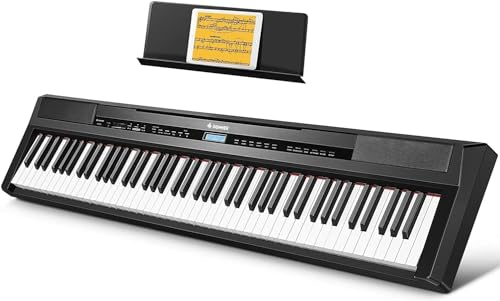
Donner DEP-20 Weighted Portable Digital Piano
Best for: Beginners needing weighted keys and portable design
- Number of Keys
- 88
- Key Action
- Hammer action
- Preset Tones
- 238
- Pedal Type
- Sustain pedal
- Speaker System
- Two 25W amplifiers
- Form Factor
- Portable
View on Amazon: Donner DEP-20 Weighted Portable Digital Piano Affiliate link
The Donner DEP-20 is a portable, 88-key digital piano featuring weighted hammer-action keys and adjustable touch response. It includes 238 preset tones and 128-note polyphony for clear sound reproduction. The unit has a backlit LCD screen, dual-tone mode, and two 25W amplifiers. Weighing 25.6 pounds, it suits beginners seeking a full-sized keyboard with basic multimedia and recording features.
Pros
- 88 full-sized hammer-action keys with adjustable touch response
- 128-note maximum polyphony for clear tone distinction
- Backlit LCD screen displays chords and notation
- Two 25W amplifiers for audio output
- Dual-tone mode allows combining two voices
Cons
- Includes only a sustain pedal; triangle pedal is listed but not standard
- No Bluetooth connectivity mentioned in specifications
- Heavy build at 25.6 pounds limits portability
Good fit if
- You need a full-sized 88-key keyboard for practice
- You want a portable instrument with built-in speakers
- You are a beginner looking for adjustable touch response
Skip if
- You require wireless Bluetooth connectivity
- You need a stand included in the base package
- You prefer a lightweight instrument under 20 pounds
Verdict: Donner DEP-20 88-Key Portable Digital Piano offers a solid entry-level experience with weighted keys and ample polyphony. It fits beginners who prioritize tactile feedback and built-in audio over wireless features.
Specifications side by side
| Spec | Donner 88-Key Velocity-Sensitive Digital Piano | Donner DEP-20 Weighted Portable Digital Piano |
|---|---|---|
| Number of Keys | 88 | 88 |
| Key Action | Velocity-sensitive | Hammer action |
| Preset Tones | 128 | 238 |
| Pedal Type | 3 piano style pedals | Sustain pedal |
| Connectivity | USB-MIDI | not stated |
| Speaker System | Two 15W speakers | Two 25W amplifiers |
| Form Factor | not stated | Portable |
| Target Audience | not stated | Beginners |
| Dimensions | 52.5 × 12.1 × 28.9 inches | 52.2 × 11.6 × 7.6 inches |
| Weight | 40.8 pounds | 25.6 pounds |
| Size | Full | Weighted Piano Only |
| Color | Classic Gray | Dull Black |
| Model | DDP-60 | EC3042 |
Frequently asked questions
Which Donner piano is better for building proper technique?
The DEP-20 is better for technique because it features weighted hammer action keys. This design mimics the resistance of an acoustic piano, helping you develop finger strength. The velocity-sensitive model lacks this weighted feel, making it less suitable for serious technical practice.
How much space does each model require on a desk?
Both pianos have a length of approximately 52 inches. The DEP-20 is more compact in height at 7.6 inches, while the velocity-sensitive model stands at 28.9 inches. You should measure your available surface area to ensure the full 88-key layout fits comfortably.
Is one model significantly lighter for frequent transport?
Yes, the DEP-20 is lighter, weighing 25.6 pounds. The velocity-sensitive model weighs 40.8 pounds. If you need to move the instrument often, the lighter DEP-20 offers a more portable solution for beginners who prioritize ease of transport over other features.
Does the velocity-sensitive model have weighted keys?
No, the velocity-sensitive model features velocity-sensitive keys rather than weighted hammer action. It prioritizes polyphony and teaching features. The DEP-20 is the only model in this comparison that provides weighted keys for a more authentic tactile experience.
What is the color option for the DEP-20?
The DEP-20 is available in Dull Black. The velocity-sensitive model comes in Classic Gray. Both are standard color options for these entry-level digital pianos, allowing you to choose based on your room decor preference.
Which model is better for beginners who need dual practice features?
The velocity-sensitive model is best for beginners needing dual practice features. It offers strong audio output and supports polyphony for teaching scenarios. The DEP-20 focuses more on tactile feedback and built-in audio without emphasizing dual practice capabilities.