Donner or KUMENG? Digital Pianos Compared in 2026
As an Amazon Associate we earn from qualifying purchases. Links on this page are affiliate links.
When you compare the Donner vs KUMENG digital piano options, you find two 88-key instruments designed for beginners. Both models offer USB-MIDI connectivity and aim to simulate acoustic piano touch for home practice. The primary difference lies in the key action mechanism. Donner uses heavy hammer action, while KUMENG provides semi-weighted keys. You also need to consider the speaker setup and pedal configuration, as these affect your playing experience and practice convenience.
Key differences
| Aspect | Donner 88-Key Weighted Digital Piano | KUMENG 88-Key Semi-Weighted Digital Piano |
|---|---|---|
| Key Action | Heavy hammer action | Semi-weighted |
| Speaker System | 2x 25W stereo speakers | Not listed |
| Pedal Type | Triple pedal | Not listed |
| Preset Tones | Not listed | 800 |
| Sound Engine | French DREAM | Sophisticated chip |
Which one should you choose?
Choose Donner 88-Key Weighted Digital Piano if
- You want heavy hammer action keys for realistic touch.
- You need built-in stereo speakers for immediate play.
- You require a triple pedal board for expression.
Choose KUMENG 88-Key Semi-Weighted Digital Piano if
- You prefer semi-weighted keys for lighter touch.
- You want access to 800 preset tones.
- You need a model with a multi-function operation panel.
Verdict: Choose the Donner if you prioritize authentic weighted keys and built-in audio for practice. Select the KUMENG if you value a larger variety of tones and a semi-weighted feel. Both serve beginners well, but the key action defines the primary experience.
Donner vs KUMENG Key Specs
Key action type
The Donner DDP-80 features a heavy hammer action keyboard. This mechanism is designed to simulate the resistance and touch of an acoustic grand piano. It captures finger strength accurately, which helps you build proper technique. The KUMENG KU-3506 uses semi-weighted keys instead. This lighter action is often preferred by beginners who are still developing their touch. It offers less resistance than the Donner’s heavy hammers. If you want a traditional piano feel for serious practice, the Donner’s weighted action is the stronger choice. For lighter, easier playability, the KUMENG option may suit your needs better.
Sound engine and polyphony
Both pianos offer 128 notes of polyphony, which allows for complex chords and sustained notes without dropping sound. The Donner DDP-80 utilizes a French DREAM sound source for its audio generation. It includes two stereo surround speakers, each rated at 25 watts, providing a robust output for room filling sound. The KUMENG KU-3506 lists 800 preset tones, offering a wide variety of instrument sounds beyond just piano. It does not specify speaker wattage or type in the provided data. The Donner provides clearer details on its audio hardware, while the KUMENG emphasizes tonal variety.
Pedal configuration
The Donner DDP-80 comes with a triple pedal setup. This typically includes sustain, sostenuto, and soft pedals, allowing for nuanced expression similar to an acoustic piano. This is standard for serious home pianos. The KUMENG KU-3506 data does not list a specific pedal type or count. While it may include a basic sustain pedal, the absence of details on a triple pedal system is notable. If you require full pedal functionality for advanced repertoire, the Donner’s included triple pedal is the clear advantage. You should verify the KUMENG’s specific pedal inclusion before purchasing.
Form factor and dimensions
The Donner DDP-80 is described as a compact unit with a height of 29.3 inches and a weight of 52.5 pounds. It features a retro wood finish. The KUMENG KU-3506 is listed as full-size with a height of only 6.5 inches, which suggests it may be a slab-style keyboard without an integrated stand. Its dimensions are 53 inches in length and 12.2 inches in width. The Donner is a complete furniture-style piano, while the KUMENG appears to be a portable keyboard. The Donner is better for a dedicated home setup, while the KUMENG is more portable.
Connectivity and compatibility
Both instruments support USB-MIDI connectivity, allowing you to connect to computers, tablets, or phones for learning apps and music software. The Donner DDP-80 explicitly mentions compatibility with iPad and mobile phone teaching apps, as well as PC music editing software for recording. The KUMENG KU-3506 also supports USB/MIDI for phone pairing and PC connection, with added support for MP3 playback. Both offer solid digital integration for modern practice routines. Neither model lists Bluetooth connectivity in the provided data. The connectivity options are essentially equal for basic digital integration.
Which Digital Piano Should You Buy
Beginners seeking realistic acoustic feel
The Donner DDP-80 features a heavy hammer action keyboard that simulates the resistance of an acoustic piano. This mechanism accurately captures finger strength, helping you build proper technique from the start. The triple pedal setup further enhances the realistic playing experience, making it ideal for serious practice.
Players wanting diverse sound options
The KUMENG KU-3506 offers 800 preset tones compared to the Donner's standard piano focus. This wide variety allows you to explore different sounds for composition or learning. The multi-functional operation panel makes it easy to switch between tones and control recording features, catering to diverse playing styles.
Users needing built-in audio playback
The KUMENG model supports MP3 playback via its USB connection. This feature lets you listen to music directly through the instrument without needing external speakers. This is useful for accompaniment practice. The Donner DDP-80 lacks this specific playback capability in its listed specifications, focusing instead on its 2x 25W speakers.
The products compared

Donner 88-Key Weighted Digital Piano
Best for: beginners wanting weighted keys and app support
- Number of Keys
- 88
- Key Action
- Heavy hammer action
- Sound Engine
- French DREAM
- Pedal Type
- Triple pedal
- Connectivity
- USB-MIDI
- Speaker System
- 2x 25W
View on Amazon: Donner 88-Key Weighted Digital Piano Affiliate link
The Donner DDP-80 is an 88-key digital piano featuring a heavy hammer action and a French DREAM sound engine. It includes 2x 25W stereo speakers and triple pedal support for realistic play. With USB-MIDI connectivity, it links to teaching apps and music software. This compact unit suits beginners seeking full-size keys and sturdy construction in a retro wood finish.
Pros
- 88-key heavy hammer action for realistic touch
- 2x 25W stereo speakers for clear audio
- Triple pedal support for expression
- USB-MIDI connectivity for app and software integration
Cons
- Requires external power adapter
- No built-in Bluetooth for wireless audio
- Limited to USB-MIDI without native Wi-Fi
Good fit if
- You want a full-size 88-key keyboard with weighted action
- You need reliable USB-MIDI connectivity for learning apps
- You prefer a sturdy, furniture-style design
Skip if
- You require built-in Bluetooth audio streaming
- You need a portable keyboard under 50 pounds
- You want a built-in display screen for settings
Verdict: Donner DDP-80 88-Key Weighted Digital Piano offers solid weighted keys and strong speakers for beginners who prioritize tactile feedback and app connectivity over wireless features.
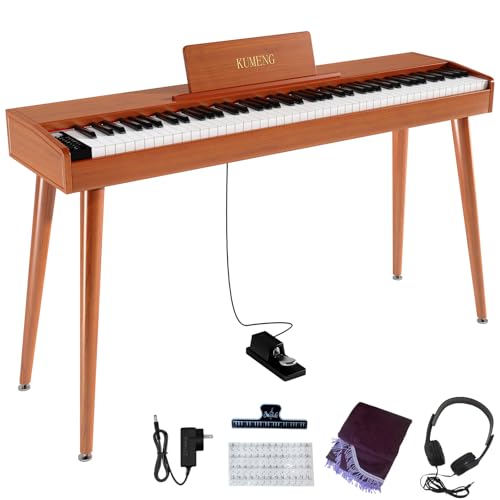
KUMENG 88-Key Semi-Weighted Digital Piano
Best for: beginners building touch sensitivity
- Number of Keys
- 88
- Key Action
- Semi-weighted
- Preset Tones
- 800
- Pedal Type
- Pedal
- Connectivity
- USB-MIDI
- Target Audience
- Beginners
View on Amazon: KUMENG 88-Key Semi-Weighted Digital Piano Affiliate link
The KUMENG KU-3506 offers 88 full-size semi-weighted keys with a brown woodgrain finish. It includes 800 preset tones and 128 polyphony for versatile sound options. The unit features USB/MIDI connectivity for app pairing and MP3 playback. This model suits beginners developing touch sensitivity. It provides a practical entry point for home practice without requiring advanced weighted key resistance.
Pros
- 88 full-size semi-weighted keys for developing touch
- 800 preset tones and 128 polyphony
- USB/MIDI connectivity for apps and MP3 playback
Cons
- Semi-weighted action lacks full hammer-weighted resistance
- No Bluetooth wireless connectivity listed
- No display screen for function tracking
Good fit if
- You are a beginner developing finger strength
- You need USB connectivity for learning apps
- You prefer a woodgrain aesthetic for home decor
Skip if
- You require fully weighted hammer-action keys
- You need wireless Bluetooth audio streaming
- You want a digital display for settings
Verdict: The KUMENG 88-Key Semi-Weighted Digital Piano fits beginners who need USB app integration and are still building touch sensitivity. It does not suit players seeking professional weighted key resistance.
Specifications side by side
| Spec | Donner 88-Key Weighted Digital Piano | KUMENG 88-Key Semi-Weighted Digital Piano |
|---|---|---|
| Number of Keys | 88 | 88 |
| Key Action | Heavy hammer action | Semi-weighted |
| Sound Engine | French DREAM | not stated |
| Preset Tones | not stated | 800 |
| Pedal Type | Triple pedal | Pedal |
| Connectivity | USB-MIDI | USB-MIDI |
| Speaker System | 2x 25W | not stated |
| Target Audience | Beginners | Beginners |
| Color | Retro Wood | Brown |
| Dimensions | 53.9 × 17.9 × 29.3 inches | 12.2 × 53 × 6.5 inches |
| Weight | 52.5 pounds | not stated |
| Size | Compact | Full-Size |
| Model | DDP-80 | KU-3506 Digital Piano with Standf |
Frequently asked questions
Which digital piano has better weighted keys for beginners?
The Donner DDP-80 features a dedicated weighted key action. This mechanism simulates the heavy resistance of an acoustic piano. It helps you build proper finger strength and technique. The KUMENG model uses semi-weighted keys. This action is lighter and may not provide the same tactile feedback for serious practice.
Does the KUMENG piano come with a stand?
Yes, the KUMENG KU-3506 includes a stand. Its model name is listed as the KU-3506 Digital Piano with Stand. This integrated design saves you the cost and effort of purchasing a separate furniture piece. The Donner DDP-80 data does not mention an included stand, so you would need to source one separately.
How do the sizes of these pianos compare?
Both are full-size 88-key instruments. The Donner DDP-80 is taller, measuring 29.3 inches in height. It also weighs 52.5 pounds. The KUMENG KU-3506 is shorter at 6.5 inches high. It is lighter and has a compact footprint. You should choose based on your available vertical space and floor load capacity.
Can I connect these pianos to a computer?
Yes, both models support USB-MIDI connectivity. This allows you to connect them to computers or tablets for music software. The Donner DDP-80 is noted for strong app support. The KUMENG model also offers USB integration. This feature lets you use learning apps or recording software with either instrument.
Which piano is better for building touch sensitivity?
The KUMENG KU-3506 is designed for beginners building touch sensitivity. Its semi-weighted action is lighter and easier to press. This can be helpful if you are just starting out. The Donner DDP-80 offers heavier weighted keys. This provides more resistance, which is better for developing strength but may feel stiff for new players.
Do these digital pianos include pedals?
The Donner DDP-80 includes a triple pedal unit. This provides sustain, soft, and sostenuto functions. The KUMENG product data does not specify included pedals. You may need to check if pedals are sold separately or included in the box for the KUMENG model. Always verify the package contents before purchasing.