Melentro or KUMENG? Digital Pianos Compared in 2026
As an Amazon Associate we earn from qualifying purchases. Links on this page are affiliate links.
This guide compares the melentro vs KUMENG digital piano options for you. Both instruments feature 88 semi-weighted keys, making them suitable for beginners building finger strength. The main difference lies in their design and connectivity. The Melentro model includes a detachable X-stand and Bluetooth support for app integration. The KUMENG unit offers a higher number of preset tones and a woodgrain finish. You will find the best fit by looking at your space and feature needs.
Key differences
| Aspect | Melentro 88-Key Semi-Weighted Digital Piano | KUMENG 88-Key Semi-Weighted Digital Piano |
|---|---|---|
| Form Factor | Portable with included detachable X-stand | Full-size unit without included stand |
| Connectivity | Bluetooth, MIDI/USB | USB/MIDI only |
| Preset Tones | Not listed | 800 |
| Polyphony | Not listed | 128 |
| Pedal Type | Sustain pedal included | Not listed |
| Color | Black (also White, Light Apricot, Brown) | Brown (also Apricot, White, Matte Black) |
Which one should you choose?
Choose Melentro 88-Key Semi-Weighted Digital Piano if
- You need a portable setup with a stand included for immediate play
- You want to connect wirelessly to music apps via Bluetooth
- You prefer a sustain pedal included in the box
Choose KUMENG 88-Key Semi-Weighted Digital Piano if
- You want access to a large library of 800 preset tones
- You need high polyphony for complex musical passages
- You prefer a matte finish with a woodgrain aesthetic
Verdict: The Melentro is the better choice if you value portability and wireless connectivity for learning. The KUMENG suits you if you prioritize a wide variety of sounds and a stationary home setup.
Melentro vs KUMENG Piano Specs
Connectivity options
Melentro offers both Bluetooth and MIDI/USB connectivity, allowing you to connect wirelessly to apps for a seamless practice experience. KUMENG provides only USB/MIDI connections, which requires cables for pairing with phones, PCs, or tablets. While KUMENG supports MP3 playback via USB, the lack of Bluetooth means you cannot enjoy wireless audio streaming or app integration without extra hardware. If you prefer a clutter-free setup with wireless capabilities, Melentro gives you more flexibility for modern digital workflows.
Sound features
KUMENG specifies 800 preset tones and 128 polyphonies, giving you a wide variety of sounds and note overlap for complex pieces. Melentro describes its sound chip as delivering rich, layered tones but does not list specific tone counts or polyphony numbers in the data. For players who want to explore diverse instruments or play dense orchestral arrangements without note dropouts, KUMENG’s explicit specifications provide a clear advantage. Melentro’s sound profile remains undefined in the provided details.
Included accessories
Melentro includes a detachable X-stand and a sustain pedal in the package, providing immediate stability and pedal functionality right out of the box. KUMENG’s data does not mention an included stand or pedal, meaning you may need to purchase these separately to achieve a comparable setup. The inclusion of the stand with Melentro makes it a more complete kit for beginners who want a ready-to-play solution without additional purchases or assembly complexities.
Portability and weight
Melentro weighs 20 pounds and is designed as a portable electric keyboard that pairs with its included stand for mobility. KUMENG’s data lists dimensions but does not specify a weight, so its portability is unclear. Melentro’s stated weight and portable form factor suggest it is easier to move between rooms or locations. If you need a keyboard that is light enough to transport frequently, Melentro’s specifications offer a clearer advantage for on-the-go use.
Key action type
Both Melentro and KUMENG feature 88 semi-weighted keys, which are touch-sensitive and ideal for building finger strength in beginners. This shared specification means both instruments provide a similar tactile response that bridges the gap between light touchscreens and heavy acoustic pianos. Since the key action type is identical for both models, there is no functional difference in how the keys feel during play. This aspect results in a tie for buyers prioritizing this specific touch characteristic.
Which Digital Piano Suits Your Needs
Beginners needing portable practice setup
The Melentro includes a detachable X-stand for immediate setup. Its Bluetooth connectivity lets you pair wirelessly with apps for lessons or playback. The semi-weighted keys offer touch sensitivity to help build finger strength. At 20 pounds, it remains portable while providing full-size functionality for home practice.
Players wanting diverse sound options
The KUMENG provides 800 preset tones and 128 polyphonies, offering extensive sound variety. Its multi-functional panel supports split functions and recording. USB/MIDI connectivity allows direct pairing with PCs or tablets for accompaniment. The matte finish and woodgrain design also suit various home decor styles while maintaining a full-size layout.
Users preferring wired digital connections
The KUMENG relies on USB and MIDI connections for device pairing. This setup supports MP3 playback via USB and direct links to computers or tablets. The 88-key semi-weighted action helps beginners develop touch. The included stand creates a stable playing surface, making it a practical choice for stationary home studios.
The products compared

Melentro 88-Key Semi-Weighted Digital Piano
Best for: Beginners needing portable practice with app support
- Number of Keys
- 88
- Key Action
- Semi-weighted
- Pedal Type
- Sustain pedal
- Connectivity
- Bluetooth, USB-MIDI
- Target Audience
- Beginners
- Color
- Black
View on Amazon: Melentro 88-Key Semi-Weighted Digital Piano Affiliate link
The Melentro 88-key digital piano features semi-weighted keys and Bluetooth connectivity. It includes a detachable X-stand and sustain pedal. The unit weighs 20 pounds and measures 50.8 inches long. This portable keyboard targets beginners with touch-sensitive keys. It offers studio-quality sound via an advanced chip. You get MIDI/USB and Bluetooth for app integration. The design supports home practice or gigging.
Pros
- 88 semi-weighted touch-sensitive keys
- Bluetooth and MIDI/USB connectivity
- Includes detachable X-stand and sustain pedal
- Portable 20-pound build with full-size keys
Cons
- Semi-weighted action lacks full hammer resistance
- No mention of polyphony or sound layers
- LCD panel limits visual feedback depth
Good fit if
- You need a portable piano for travel
- You want Bluetooth app integration
- You are a beginner building finger strength
Skip if
- You require fully weighted hammer action
- You need extensive sound customization
- You prefer a non-portable console design
Verdict: Melentro 88-Key Semi-Weighted Digital Piano suits beginners seeking a portable, Bluetooth-enabled keyboard with included stand support.
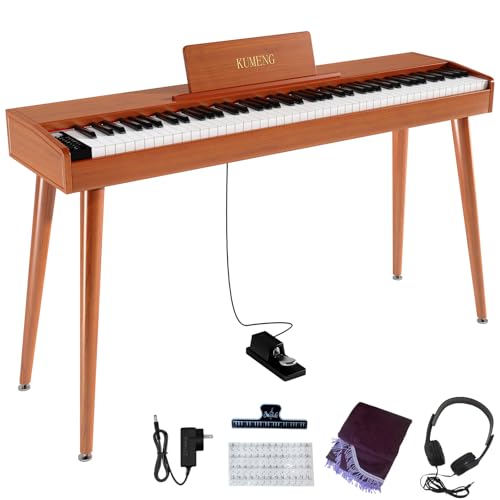
KUMENG 88-Key Semi-Weighted Digital Piano
Best for: beginners needing full-size keys and app support
- Number of Keys
- 88
- Key Action
- Semi-weighted
- Preset Tones
- 800
- Pedal Type
- Pedal
- Connectivity
- USB-MIDI
- Target Audience
- Beginners
View on Amazon: KUMENG 88-Key Semi-Weighted Digital Piano Affiliate link
The KUMENG digital piano features 88 full-size semi-weighted keys. It includes 800 preset tones and 128 notes of polyphony. Connectivity options include USB and MIDI for linking to computers or tablets. The unit measures 53 inches wide and 6.5 inches high. This model suits beginners who need a full keyboard for learning. It offers a straightforward interface for basic practice sessions.
Pros
- 88 full-size semi-weighted keys for touch development
- 128 polyphony supports complex playing styles
- 800 preset tones for diverse sounds
- USB and MIDI connectivity for app integration
Cons
- Semi-weighted keys lack the resistance of fully weighted actions
- No Bluetooth connectivity for wireless audio streaming
- Limited to USB/MIDI without dedicated display screen
Good fit if
- You are a beginner developing finger strength
- You need a full 88-key layout for practice
- You want to connect to learning apps via USB
Skip if
- You require fully weighted hammer action keys
- You need wireless Bluetooth audio output
- You prefer a compact portable keyboard under 50 inches
Verdict: KUMENG 88-Key Semi-Weighted Digital Piano is a solid entry-level instrument for students who need a full-sized keyboard with app connectivity. It fits learners prioritizing key count and basic sound variety over advanced touch response.
Specifications side by side
| Spec | Melentro 88-Key Semi-Weighted Digital Piano | KUMENG 88-Key Semi-Weighted Digital Piano |
|---|---|---|
| Number of Keys | 88 | 88 |
| Key Action | Semi-weighted | Semi-weighted |
| Preset Tones | not stated | 800 |
| Pedal Type | Sustain pedal | Pedal |
| Connectivity | Bluetooth, USB-MIDI | USB-MIDI |
| Target Audience | Beginners | Beginners |
| Color | Black | Brown |
| Dimensions | 50.8 × 9.68 × 30.8 inches | 12.2 × 53 × 6.5 inches |
| Weight | 20 pounds | not stated |
| Size | Full | Full-Size |
| Model | 0725-A010 | KU-3506 Digital Piano with Standf |
Frequently asked questions
Is the Melento better than KUMENG for beginners?
The Melentro is often preferred for beginners who want portability and app integration. It features Bluetooth connectivity, allowing wireless pairing with practice apps. The included detachable X-stand makes setup quick. KUMENG relies on USB cables for app connections, which can be less convenient for mobile practice sessions.
Does KUMENG have Bluetooth connectivity?
No, the KUMENG model does not support Bluetooth. It provides only USB/MIDI connections for linking to devices. You must use cables to connect the piano to phones, tablets, or computers for app usage. This contrasts with the Melentro, which offers wireless connectivity for a cleaner setup.
What is the weight difference between the two pianos?
The Melentro weighs 20 pounds, making it relatively lightweight for transport. The KUMENG specifications do not list a weight, but its dimensions suggest a different form factor. The Melentro’s compact design and lower weight make it easier to move for practice sessions compared to heavier stationary setups.
Are the keys semi-weighted on both models?
Yes, both the Melentro and KUMENG feature semi-weighted keys. This action helps beginners build finger strength without the heaviness of full hammer actions. The Melentro offers 88 keys with this action, while the KUMENG also provides 88 semi-weighted keys, ensuring similar tactile feedback for learning techniques.
Which piano includes a stand?
The Melentro includes a detachable X-stand for immediate setup. This allows you to place the keyboard at a comfortable height without buying extra furniture. The KUMENG data does not mention an included stand, so you may need to source one separately if you prefer a raised playing position.
Can I use apps with the KUMENG piano?
You can use apps with the KUMENG piano via its USB/MIDI connection. This requires a cable to link the instrument to your device. While it supports app connectivity, it lacks the wireless convenience of the Melentro’s Bluetooth feature. You must manage cables during your practice sessions.
What are the dimensions of the Melentro?
The Melentro measures 50.8 inches in length, 30.8 inches in height, and 9.68 inches in width. These dimensions indicate a compact, portable design. The KUMENG has different measurements, with a length of 12.2 inches and a width of 53 inches, suggesting a different physical layout for your space.
Is the Melentro portable?
Yes, the Melentro is designed for portability. It weighs only 20 pounds and includes a detachable stand for easy transport. Its compact size fits well in smaller spaces. The KUMENG is described as a full-size instrument, which may be less convenient for moving between rooms or locations.