WENCAI Digital Piano 88 Key or WENCAI 88 Keys Fully Weighted Digital Piano? Which WENCAI Model to Buy
As an Amazon Associate we earn from qualifying purchases. Links on this page are affiliate links.
When comparing the wencai digital piano 88 key vs 88 keys fully weighted digital piano, you see two instruments from the same brand. Both offer 88 keys with weighted actions and French audio chips. The main difference lies in their sound engines and pedal setups. One model features a standard stereo setup with two pedals, while the other includes a three-pedal system and higher wattage speakers. You need to check the specs to see which fits your practice needs.
Key differences
| Aspect | WENCAI 88-Key Fully Weighted Digital Piano | WENCAI 88-Key Fully Weighted Digital Piano |
|---|---|---|
| Key Action | Progressive hammer action | Fully weighted hammer |
| Preset Tones | 128 | 380 |
| Speaker System | Dual stereo speakers | A pair of 4 ohm 15 watt speakers |
| Pedal Type | Metal pedals | Metal three-pedal |
| Color | White | Beige |
Which one should you choose?
Choose WENCAI 88-Key Fully Weighted Digital Piano if
- You need 380 tones for varied sound exploration and composition.
- You want a three-pedal setup for more precise emotional control.
- You prefer a higher wattage speaker system for richer sound output.
Verdict: The first model suits beginners who need straightforward tools and demonstration songs. The second model is better for players who want more tones and a three-pedal system. Choose based on your need for sound variety and pedal complexity.
WENCAI Piano Spec Comparison
Key action feel
Both models use weighted hammer mechanisms to mimic acoustic piano resistance. Product A, the WENCAI 88-Key Fully Weighted Digital Piano, specifies a progressive hammer action. This design adjusts key weight to simulate the heavier bass and lighter treble of a real piano. Product B, the WENCAI 88-Key Fully Weighted Digital Piano (Beige), lists a fully weighted hammer action. It also highlights 16 levels of touch sensitivity that you can adjust based on playing strength. While both provide weighted resistance, Product B offers explicit adjustable sensitivity levels, giving you more control over how the keys respond to your touch.
Preset tones
The number of available sounds is a major difference between these two instruments. Product A provides 128 timbres for your compositions and practice sessions. This selection covers standard piano, electric piano, organ, and string sounds. Product B significantly expands this library with 380 tones. This larger selection includes the standard voices plus a wider variety of orchestral, synth, and special effect sounds. If you need a broad palette of instruments for diverse musical styles or layering, Product B offers more than double the sonic options found in Product A.
Pedal setup
The included pedals affect your expression and control during performance. Product A comes with metal pedals, though the description notes the sockets are on the bottom of the body. It does not specify the exact number of pedals included in the box. Product B explicitly includes a metal three-pedal setup. This typically provides sustain, sostenuto, and soft functions, allowing for nuanced articulation. Having three dedicated metal pedals is standard for serious practice. Product B’s explicit three-pedal configuration offers a more complete traditional piano experience compared to the unspecified pedal count in Product A.
Speaker power
Speaker output determines volume and clarity without external amplification. Product A features high-power dual stereo speakers powered by a French digital chip. It does not list specific wattage or impedance ratings. Product B uses a French DREAM audio chip paired with a pair of 4 ohm 15-watt high-output speakers. The 15-watt rating provides a concrete measure of volume potential. Higher wattage generally means louder output and better bass response. While both use French chips, Product B’s specified 15-watt speakers offer a measurable advantage in raw power and volume capacity.
Included accessories
What you get in the box impacts immediate usability. Both products include a power supply that is PES certified and an English instruction manual or manual. Product A includes a pedal and mentions an installation video. Product B includes a pedal and also mentions an installation video. Product B adds a unique one-piece cushioned drop piano cover with an anti-pinch design. This cover doubles as a table when closed. Product A lacks this specific furniture feature. The anti-pinch cover in Product B adds safety and versatility, making it the more complete package for home placement.
Which WENCAI Piano Suits Your Needs
You want adjustable touch sensitivity
Product B offers 16 levels of touch sensitivity. You can adjust this setting to match your playing strength. This feature allows for nuanced control over volume and dynamics. Product A relies on standard velocity response without explicit level adjustments. If you prefer customizing how hard you must press for different volumes, this model is the better choice.
You need more tone variety
Product B provides 380 preset tones. This gives you a much wider palette for composition and practice. Product A lists only 128 timbres. If you explore different instrument sounds frequently, the higher count in Product B offers greater versatility. This spec directly impacts your ability to experiment with various musical styles without needing external sound modules.
You prefer a protective cover
Product B includes a one-piece cushioned drop cover. It closes slowly to prevent pinching and doubles as a shelf for books. Product A does not mention a cover. If you want to keep dust off the keys and need extra surface space, this physical accessory adds practical value. It also enhances the instrument's appearance as a piece of furniture.
You want a three-pedal setup
Product B features metal three pedals. This allows for standard sustain, soft, and sostenuto control. Product A includes metal pedals but does not specify a three-pedal configuration. If you are learning traditional piano techniques that require multiple pedal expressions, the three-pedal design offers more precise emotional control and technical capability during your practice sessions.
The products compared
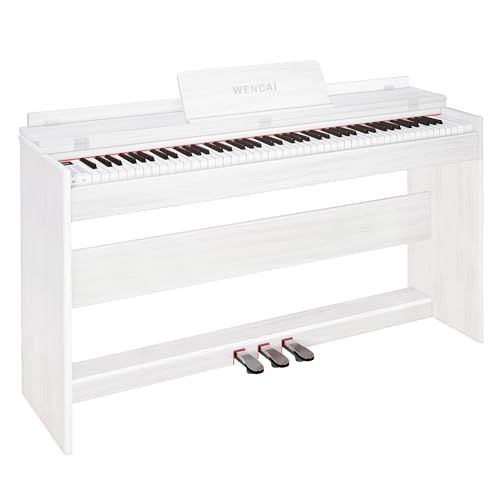
WENCAI 88-Key Fully Weighted Digital Piano
Best for: students needing weighted keys and MIDI
- Number of Keys
- 88
- Key Action
- Progressive hammer action
- Form Factor
- Upright
- Sound Engine
- French digital chip
- Preset Tones
- 128
- Pedal Type
- Triple pedal
View on Amazon: WENCAI 88-Key Fully Weighted Digital Piano Affiliate link
The WENCAI BL-8812 is an 88-key digital piano featuring progressive hammer action and a French digital chip. It includes dual stereo speakers, 128 preset tones, and 100 rhythms. The unit connects via MIDI/USB and supports headphone practice. This model suits players seeking a fully weighted keyboard for self-study or teaching, with included metal pedals for expression.
Pros
- 88 keys with progressive hammer action
- French digital chip sound engine
- Dual stereo speakers for powerful output
- 128 preset tones and 100 rhythms
- Includes metal pedals for control
Cons
- Pedal sockets located on the bottom of the body
- No Bluetooth connectivity listed
- No built-in display mentioned
Good fit if
- You want a fully weighted keyboard for practice
- You need MIDI/USB connectivity for computer use
- You prefer a white finish for your setup
Skip if
- You require wireless Bluetooth connectivity
- You need a built-in LCD display
- You prefer a beige color scheme
Verdict: WENCAI White 88-Key Weighted Digital Piano offers a solid weighted keybed and French chip sound for students. It fits learners who value wired connectivity and metal pedals over wireless features.

WENCAI 88-Key Fully Weighted Digital Piano
Best for: Players wanting weighted keys and rich sound
- Number of Keys
- 88
- Key Action
- Fully weighted hammer
- Sound Engine
- French DREAM audio chip
- Preset Tones
- 380
- Pedal Type
- Metal three-pedal
- Connectivity
- USB-MIDI
View on Amazon: WENCAI 88-Key Fully Weighted Digital Piano Affiliate link
This WENCAI model features 88 fully weighted hammer keys with 16 levels of touch sensitivity. It uses a French DREAM audio chip paired with 15-watt speakers for rich sound. The unit includes 380 tones, 128 rhythms, and a metal three-pedal system. A new anti-pinch cover adds safety and surface space. It connects via USB-MIDI for music creation. This beige keyboard suits players seeking realistic key action and versatile sounds.
Pros
- 88 fully weighted hammer keys with 16 touch sensitivity levels
- French DREAM audio chip with 15-watt speakers
- Metal three-pedal system for hands-free control
- 380 tones and 128 rhythms for exploration
- Anti-pinch drop cover with storage surface
Cons
- No Bluetooth connectivity listed in specifications
- No display screen mentioned in features
- Limited to USB-MIDI without audio output ports
Good fit if
- You want weighted keys for realistic feel
- You need multiple tones and rhythms
- You prefer a metal pedal system
Skip if
- You require Bluetooth wireless connectivity
- You need a built-in display screen
- You prefer white color over beige
Verdict: WENCAI 88-Key Digital Piano Beige offers solid weighted key action and rich sound through its DREAM chip and 15-watt speakers. It fits players who value tactile feedback and diverse tones without needing wireless features.
Specifications side by side
| Spec | WENCAI 88-Key Fully Weighted Digital Piano | WENCAI 88-Key Fully Weighted Digital Piano |
|---|---|---|
| Number of Keys | 88 | 88 |
| Key Action | Progressive hammer action | Fully weighted hammer |
| Form Factor | Upright | not stated |
| Sound Engine | French digital chip | French DREAM audio chip |
| Preset Tones | 128 | 380 |
| Pedal Type | Triple pedal | Metal three-pedal |
| Connectivity | MIDI/USB | USB-MIDI |
| Speaker System | Dual stereo speakers | A pair of 4 ohm 15 watt speakers |
| Target Audience | Beginners | not stated |
| Color | White | beige |
| Size | Weighted | not stated |
| Model | BL-8812 | C01 |
Frequently asked questions
Is the WENCAI BL-8812 suitable for serious students?
Yes, the WENCAI BL-8812 is designed for students needing weighted keys and MIDI connectivity. It features a solid weighted keybed and uses a French chip for sound. This model prioritizes wired connections and metal pedals, making it a practical choice for learners who value tactile feedback over wireless features.
What sound engine does the beige WENCAI piano use?
The beige WENCAI model, identified as the C01, uses a DREAM chip for its sound engine. This component helps deliver rich tones through its 15-watt speakers. You get diverse musical options without needing wireless capabilities, focusing instead on solid weighted key action and clear audio output for practice sessions.
Do both WENCAI models have 88 keys?
Yes, both the WENCAI BL-8812 and the C01 model feature 88 keys. They both utilize weighted actions to mimic the feel of an acoustic piano. This standard configuration ensures you have the full range required for learning classical repertoire and advanced techniques on a digital instrument.
Which WENCAI piano offers adjustable touch sensitivity?
The beige WENCAI C01 model offers 16 levels of touch sensitivity. This allows you to adjust the setting to match your playing strength. You can achieve nuanced control over volume and dynamics. The white BL-8812 relies on standard settings, making the C01 better for dynamic expression.
Can I connect MIDI devices to the WENCAI BL-8812?
Yes, the WENCAI BL-8812 is best for students needing MIDI connectivity. It supports wired connections for linking with computers or other gear. This focus on wired utility makes it a reliable option for those who need to integrate their piano into a digital music production setup without wireless interference.
What is the main difference between the white and beige models?
The main difference lies in their sound engines and connectivity. The white BL-8812 uses a French chip and emphasizes wired MIDI and metal pedals. The beige C01 uses a DREAM chip with 15-watt speakers and offers 16 levels of touch sensitivity. Choose based on your need for dynamic control versus wired utility.