MOOG Muse 8-Voice Analog Polyphonic Review: Specs, Pros and Cons
As an Amazon Associate we earn from qualifying purchases. Links on this page are affiliate links.
This moog muse 8 voice analog polyphonic review focuses on a synthesizer built for studio and stage use. It delivers eight analog voices, ensuring rich, kinetic sound character. The unit measures 39 inches wide and weighs 32 pounds, making it a substantial piece of gear. It features two voltage-controlled oscillators per voice, dual filters, and a stereo voltage-controlled amplifier. With 256 preset sounds, including 224 factory patches, it offers extensive sonic variety. The layout uses intuitive knob-per-function controls for direct sound shaping.
What stands out
- Eight analog voices with two VCOs each
- 256 preset sounds including 224 factory patches
- Stereo Diffusion Delay processor for complex echoes
- 16 banks of 16 patches for 256 patch memory
Who it fits
Good fit for
This instrument suits producers and sound designers who want deep analog texture without programming complexity. The knob-per-function layout and 'More' menus allow quick adjustments. Musicians needing a performance centerpiece will appreciate the powerful arpeggiator and polyphonic sequencer. The stereo VCA and dual filters provide the classic Moog warmth. It fits well in setups where tactile control and generative behaviors are priorities.
Who should skip it
You should look elsewhere if you need a portable keyboard. At 32 pounds and 39 inches wide, the Muse is not designed for easy transport. If you require digital samples or virtual instrument integration, this purely analog engine may not meet your needs. Users seeking a lightweight stage piano or a compact workstation will find this unit too large and specialized. It is built for dedicated synthesis, not general keyboard playing.
Verdict: The Moog Muse offers robust analog sound and deep editing capabilities for serious synthesis work. Its substantial build and specialized features make it a strong choice for studio-focused musicians.
MOOG Muse Key Specs Explained
Sound Engine: Analog
This synthesizer uses analog circuitry for sound generation rather than digital samples. You get continuous voltage control, which creates the warm, organic tones associated with vintage gear. This appeals to players seeking rich, dynamic textures that change with your touch. When shopping for digital pianos, note that this is a pure synth, not a piano emulator, so it suits sound design and electronic music rather than traditional keyboard playing.
Preset Sounds: 256 (224 factory)
The unit includes 256 total patch memories, with 224 pre-loaded by the manufacturer. You retain two banks for your own custom creations. This provides ample starting points for various genres without requiring immediate programming. For digital piano buyers, this indicates a focus on synthesis variety rather than acoustic piano realism. You can explore different timbres quickly, making it ideal for live performance or studio experimentation where variety is key.
Width: 39 inches
The synthesizer spans 39 inches in width, which is significantly wider than standard 88-key digital pianos. You need a dedicated desk or stand to accommodate this footprint comfortably. This size reflects the extensive control surface and internal components. When comparing to digital pianos, consider your available space carefully. This unit is a statement piece that requires more room, making it better suited for home studios with dedicated areas rather than cramped living spaces.
Weight: 32 pounds
Weighing 32 pounds, the unit is heavy enough to remain stable during intense playing but portable enough for transport with care. You benefit from a solid build that minimizes vibration and resonance issues. Digital pianos often vary widely in weight, but this analog synth offers a consistent, robust feel. Ensure your stand can support this load securely. The weight also suggests high-quality internal components, contributing to the instrument's durability and long-term reliability for serious musicians.
Included Accessories: IEC cable, quick start guide
The package includes an IEC power cable and a quick start guide for immediate setup. You do not need to purchase a separate power cord, which simplifies the initial experience. The guide helps you navigate the basic functions quickly. For digital piano shoppers, this is a standard inclusion. It ensures you can power on and explore the interface without delay. Always verify your local power outlet compatibility with the included cable type to avoid additional purchases.
Design and Build Specifications
According to the listing, the MOOG Muse features a black finish across its chassis. The unit measures 39 inches wide, 17 inches deep, and 4.5 inches high. It weighs 32 pounds. These dimensions indicate a substantial footprint that requires dedicated desk or rack space. The weight suggests solid internal construction but also means you need a sturdy stand or table to support it safely.
The control layout is described as knob-per-function with intuitive access. This design prioritizes direct tactile interaction over screen navigation. You adjust parameters by turning physical knobs rather than digging through menus. The listing notes 'More' menus for every module, which allows for deeper editing without cluttering the main interface. This approach suits players who prefer immediate sound sculpting during performance or studio sessions.
The build quality aligns with its role as both a studio centerpiece and performance instrument. The discrete oscillators and saturating mixer are housed within this robust enclosure. The included accessories consist of an IEC cable and a quick start guide. There is no mention of a carrying case or additional hardware in the box. You should plan for transport protection if you move the unit between locations regularly. The physical design supports its function as a serious analog polyphonic synthesizer for dedicated musicians.
Setup and Everyday Use Guide
Setting up the MOOG Muse begins with connecting the included IEC power cable. You will also find a quick start guide and safety manual in the box to help with initial configuration. The unit is a substantial piece of equipment, measuring 39 inches wide and weighing 32 pounds. You need a sturdy surface that can support this weight and accommodate its 17-inch depth.
The interface is designed for direct interaction. It features a knob-per-function layout, which allows you to adjust parameters without navigating complex menus. Each module includes a 'More' menu for deeper editing. This physical control scheme supports immediate sound shaping during both studio sessions and live performances. You can manipulate the dual VCOs, modulation VCO, and dual VCFs directly.
For daily use, the synthesizer offers extensive memory and sequencing capabilities. It stores 256 patches across 16 banks. The unit ships with 224 factory presets, leaving two banks for your custom sounds. You can use the 64-step sequencer and polyphonic sequencer to create generative patterns. The stereo Diffusion Delay processor adds depth through multi-tap and filter behaviors.
The arpeggiator and chord memory features provide additional creative tools. These elements work together to fuel musical exploration. The analog engine ensures that every adjustment affects the sound in real time. You get continuous voltage control for warm, organic tones. This setup supports both detailed sound design and immediate performance needs.
Before You Buy This Synthesizer
The MOOG Muse is a dedicated analog synthesizer, not a digital piano. You must check your existing gear for compatibility. Ensure your audio interface or mixer has the necessary inputs to handle its stereo output. The unit requires a standard IEC power cable, which is included. You should also verify that your workspace can accommodate its 39-inch width and 32-pound weight. This is not a portable keyboard for casual playing. It is a studio centerpiece. You will need adequate ventilation around the chassis to prevent overheating during long sessions. Unlike the other 1 options on this page, this unit offers discrete analog circuitry. It lacks the multi-timbral flexibility of digital workstations. If you want layered piano sounds or built-in speakers, this is not the right choice. It is for sound design and specific analog textures. Plan your signal chain carefully before purchasing.
Check before you buy
- Verify audio interface inputs match the stereo output requirements.
- Confirm desk space fits the 39-inch width and 32-pound weight.
- Check if you need additional cables for your current setup.
- Ensure you want pure analog sound rather than digital versatility.
The product at a glance
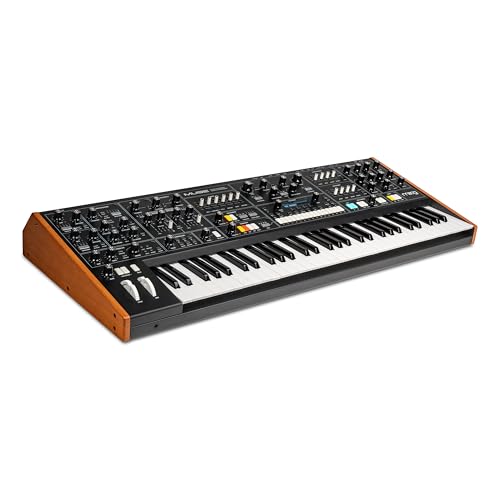
MOOG Muse 8-Voice Analog Synthesizer
Best for: Analog sound design and performance
- Number of Keys
- 61
- Sound Engine
- 8-voice analog polyphonic
- Preset Sounds
- 256 patches
- Included Accessories
- IEC Cable, Quick Start Guide
- Color
- Black
- Special Features
- Sequencer
View on Amazon: MOOG Muse 8-Voice Analog Synthesizer Affiliate link
The Moog Muse is an 8-voice analog polyphonic synthesizer designed for studio and performance use. It features discrete oscillators, dual transistor ladder filters, and a stereo VCA. The unit includes a 64-step sequencer with 256 patch memories and a stereo diffusion delay processor. Weighing 32 pounds, it offers a knob-per-function layout for intuitive control. This instrument suits musicians seeking rich, kinetic analog tones and deep generative sound design capabilities.
Pros
- 8-voice analog polyphony with dual VCOs per voice
- 256 patch memories including 224 factory presets
- Stereo diffusion delay with multi-tap behaviors
- Polyphonic sequencer and chord memory for generative music
- Intuitive knob-per-function layout with 'More' menus
Cons
- Heavy at 32 pounds, making portability difficult
- No Bluetooth connectivity listed in specifications
- No dedicated display screen for patch editing
Good fit if
- You want warm, discrete analog sound character
- You need deep sound design tools like a polyphonic sequencer
- You prefer tactile knob controls over menu diving
Skip if
- You require wireless Bluetooth connectivity
- You need a lightweight instrument for frequent travel
- You prefer digital modeling over analog circuitry
Verdict: The Moog Muse 8-Voice Analog Synthesizer delivers robust analog sound and deep sequencing for dedicated sound designers. It fits musicians who value tactile control and rich, discrete oscillator tones in a studio setting.
Specifications side by side
| Spec | MOOG Muse 8-Voice Analog Synthesizer |
|---|---|
| Number of Keys | 61 |
| Sound Engine | 8-voice analog polyphonic |
| Preset Sounds | 256 patches |
| Included Accessories | IEC Cable, Quick Start Guide |
| Color | Black |
| Special Features | Sequencer |
| Dimensions | 17 × 39 × 4.5 inches |
| Weight | 32 pounds |
| Model | MUSE |
Frequently asked questions
Is the Moog Muse 8-Voice Analog Synthesizer a digital piano?
No. The Moog Muse is a dedicated analog synthesizer, not a digital piano. It uses analog circuitry for sound generation. This design focuses on rich, discrete oscillator tones and tactile control. It is built for sound designers and musicians who prefer continuous voltage control over digital samples.
How many voices does the Moog Muse polyphonic synth have?
It features eight analog voices. This polyphony level allows for complex chords and layered textures. The eight voices ensure the sound remains rich and kinetic during performance. It fits well in studio settings where deep sequencing and robust analog character are required.
What are the physical dimensions of the Moog Muse synthesizer?
The unit measures 39 inches wide, 17 inches deep, and 4.5 inches high. These dimensions indicate a substantial footprint. You need dedicated desk space to accommodate its size. The black finish adds to its professional studio appearance, making it a significant piece of equipment.
How heavy is the Moog Muse 8-voice analog synth?
It weighs 32 pounds. This weight reflects its solid build quality and internal analog components. You should plan for stable support when placing it on a stand or desk. The substantial mass helps reduce vibration and ensures durability during regular use in a studio environment.
Who is the Moog Muse synthesizer best for?
It is best for analog sound design and performance. The device suits musicians who value tactile control and rich tones. It is ideal for dedicated sound designers working in a studio setting. If you seek discrete oscillator tones and deep sequencing capabilities, this synthesizer aligns with your needs.
What color is the Moog Muse synthesizer chassis?
The chassis features a black finish. This color is consistent across the entire unit. The black design provides a professional look that blends well into typical studio environments. It offers a sleek aesthetic that complements other audio equipment on your desk or rack.