Special Features Explained: What It Means for Digital Pianos
As an Amazon Associate we earn from qualifying purchases. Links on this page are affiliate links.
Special Features Explained for Keyboards
Digital pianists often encounter a list of extra capabilities on product pages. These are special features explained in this guide. They range from basic audio output to advanced recording tools. You should check these specs to match your workflow needs. Not every player needs every function. Understanding what each feature does helps you avoid buying hardware you will never use.
Built-in speakers allow you to play without external gear. They provide immediate sound when you press a key. Listings usually state the wattage or number of speaker units. Higher wattage generally means louder volume and better bass response. You need sufficient power if you plan to practice in a larger room or play with others. Without them, you must always connect headphones or an amplifier.
Lighted keys guide your fingers during lessons. They illuminate specific keys to show which notes to press. This feature is common in beginner models and educational apps. It helps new players learn songs faster by removing the guesswork. You do not need this if you already read music or know the layout. It is purely a learning aid.
An LCD screen displays menu settings and current modes. It shows volume levels, selected voices, and recording status. This visual feedback is essential for navigating complex menus. Without a screen, you might need to rely on small LED indicators or a mobile app. A clear display makes adjustments quick and precise.
A sequencer records your performance. It captures note data rather than audio. You can edit individual notes, change instruments, or loop sections. This tool is vital for composers and producers. It allows you to build tracks layer by layer. You should look for the number of tracks and resolution if you plan to create music. These features define the instrument's versatility beyond simple playing.
Special Features Compared
Built-In Speakers
Built-in speakers provide immediate audio output without needing external amplification. This feature simplifies setup for home practice or casual playing. You hear sound directly from the instrument body. The Yamaha P45 and STRICH SDP-300W both include this capability. It suits beginners who want a straightforward experience. The trade-off is that speaker quality varies. High-end models offer richer tone, while basic units may sound thin. You cannot upgrade these speakers later. If you plan to perform live or record studio-quality audio, you will likely need external gear anyway. For simple practice, this feature is sufficient.
Lighted Keys
Lighted keys use LEDs to guide your fingers during lessons. This feature helps beginners learn songs by showing which keys to press. The ONE SP-PLAY and MUSTAR U6010404000 feature this technology. It is ideal for visual learners who benefit from interactive guidance. The trade-off is distraction. Some players find the lights annoying once they learn the songs. It also adds power consumption. You cannot easily remove the lights if you dislike them. This feature is best for absolute novices starting their journey. It is less useful for advanced players who read sheet music or rely on muscle memory. Check if the lights are customizable in brightness.
LCD Screen
An LCD screen displays settings, tone selections, and menu options. This feature allows you to adjust parameters without memorizing button combinations. The Donner DDP-200 and GLARRY GLDP001 include these displays. It suits players who want clear visibility of their settings. The trade-off is added cost and complexity. Screens can fail over time. They also take up panel space. Small screens may be hard to read in low light. You benefit from this feature if you frequently change sounds or settings. It is less critical if you only use a few presets. Ensure the text is legible and the backlight is adequate for your practice environment.
Sequencer
A sequencer records and plays back your performances. This feature allows you to capture ideas or practice parts slowly. It is a powerful tool for composition and learning. However, none of the listed products highlight a built-in sequencer in their special features. This means you may need to use external software or apps to record. The trade-off is that you lose the convenience of on-instrument recording. You must connect to a computer or mobile device. This limits portability and spontaneity. If recording is essential, verify connectivity options like USB-MIDI. This feature is vital for serious musicians who need to review their progress.
Who Needs These Special Features
Who needs it
You should prioritize instruments with these specs if you value convenience and creative control. Built-in speakers allow for immediate playback without external gear, simplifying your setup for home practice. Lighted keys assist beginners in learning note locations quickly, reducing the cognitive load during early stages. An LCD screen provides clear visual feedback for settings and sequencer data, which is essential when navigating complex menus without guessing. A built-in sequencer lets you record, edit, and playback your performances directly on the instrument. This is crucial for songwriters or students who want to review their progress and structure compositions without needing a computer. If you want an all-in-one solution that supports learning and creation, these features combine to offer a complete, self-contained experience. They remove the friction of connecting additional devices, making practice sessions more fluid and productive for users who prefer a streamlined workflow.
Who can skip it
You can ignore these features if you already have a robust studio setup or prefer minimalism. External speakers often deliver superior sound quality compared to built-in units, so audiophiles may find the integrated options limiting. Lighted keys are generally unnecessary for experienced players who have memorized the keyboard layout; they can even be distracting during advanced performance. An LCD screen adds cost and potential points of failure; many musicians prefer tactile buttons or direct digital connection to a tablet or computer for better visibility. A sequencer is redundant if you use a dedicated digital audio workstation on your laptop. For these users, prioritizing key action quality, authentic tone generation, and connectivity options like MIDI or USB audio is far more important. These special features are convenience add-ons, not core performance indicators. You will get better value by investing in the instrument’s primary sound and touch capabilities rather than auxiliary tools you do not use.
Special Features Glossary
Built-in speakers
Integrated amplifiers and drivers that produce sound directly from the piano body. This allows immediate playback without needing external amplifiers or headphones, simplifying your home setup.
Lighted keys
Keys equipped with small LEDs that illuminate to indicate specific notes. This visual aid helps beginners learn note locations and follow on-screen tutorials more quickly.
Key action
The mechanical mechanism that moves the keys and returns them. It determines the touch weight and resistance, simulating the feel of an acoustic piano hammer action.
Number of keys
The total count of playable keys on the instrument. Most digital pianos offer 88 keys for full range, while portable keyboards may have 61 or 76 keys.
Pedal type
The style of the sustain or expression pedal included. Options range from simple plastic half-pedal models to weighted wooden pedals that mimic acoustic piano hardware.
Connectivity
The available ports for linking to other devices. Common options include USB for data, MIDI for control, and headphone jacks for silent practice sessions.
Quick picks
| # | Product | Best for | Price |
|---|---|---|---|
| 1 | Yamaha 88-Key Weighted Portable Digital Piano | beginners seeking simple weighted keys | Check price of Yamaha 88-Key Weighted Portable Digital Piano on Amazon |
| 2 | The ONE SP-PLAY 88-Key Digital Piano | beginners wanting lighted keys and powerful speakers | Check price of The ONE SP-PLAY 88-Key Digital Piano on Amazon |
| 3 | Donner 88-Key Upright Hammer Action Piano | Players wanting an upright with an LCD display | Check price of Donner 88-Key Upright Hammer Action Piano on Amazon |
| 4 | STRICH 88-Key Walnut Hammer Action Digital Piano | Home players wanting weighted keys and app connectivity | Check price of STRICH 88-Key Walnut Hammer Action Digital Piano on Amazon |
| 5 | MUSTAR 88-Key Lighted Digital Piano | Beginners seeking visual key guidance | Check price of MUSTAR 88-Key Lighted Digital Piano on Amazon |
| 6 | GLARRY 88-Key Heavy Hammer Upright Digital Piano | beginners wanting LCD screens and upright form | Check price of GLARRY 88-Key Heavy Hammer Upright Digital Piano on Amazon |
Our 6 picks

Yamaha 88-Key Weighted Portable Digital Piano
Best for: beginners seeking simple weighted keys
- Special Features
- Built-In Speakers (what this guide is about)
- Number of Keys
- 88
- Key Action
- Weighted
- Form Factor
- Portable
- Preset Tones
- 10
- Pedal Type
- Sustain foot switch
View on Amazon: Yamaha 88-Key Weighted Portable Digital Piano Affiliate link
This Yamaha portable digital piano features 88 weighted keys and built-in speakers. It offers 10 preset tones and USB connectivity. The sustain foot switch is included. It is designed for beginners who need a compact, touch-sensitive instrument. The simple one-button operation keeps you focused on playing. It replicates an acoustic piano feel in a portable form.
Pros
- 88 weighted keys for dynamic performance
- Built-in speakers for immediate sound
- Includes sustain foot switch
- Compact portable form factor
- USB connectivity
Cons
- Only 10 preset tones
- No LCD screen for settings
- No sequencer or advanced features
Good fit if
- You want a simple, no-fuss keyboard
- You need built-in speakers
- You are a beginner learning piano
Skip if
- You need a large LCD screen
- You require a sequencer for recording
- You want more than 10 voices
Verdict: Yamaha P45 88-Key Weighted Portable Piano suits beginners who prioritize basic weighted keys and built-in speakers over complex features like screens or sequencing.
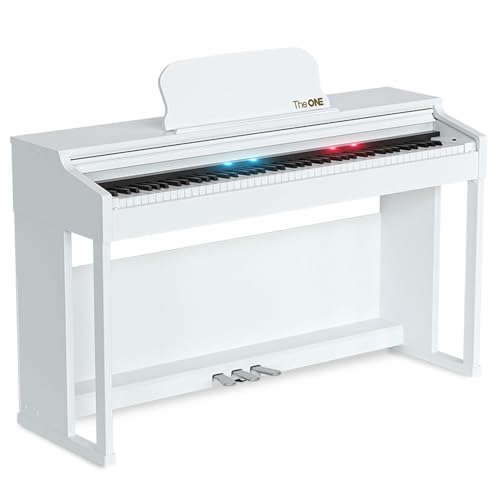
The ONE SP-PLAY 88-Key Digital Piano
Best for: beginners wanting lighted keys and powerful speakers
- Special Features
- Lighted Keys (what this guide is about)
- Number of Keys
- 88
- Key Action
- Progressive weighted hammer action
- Preset Tones
- 426
- Pedal Type
- 3-pedal unit
- Connectivity
- USB-MIDI, AUX in/out
View on Amazon: The ONE SP-PLAY 88-Key Digital Piano Affiliate link
This 88-key digital piano features progressive hammer-action weighted keys paired with integrated key lights for guided practice. It includes a four-speaker sound system with two 20W tweeters and two 25W woofers, 426 preset tones, and a triple-pedal unit. Operating through a connected companion app, it suits you if you want visual guidance with high speaker output.
Pros
- Key-lighting technology syncs directly with sheet music scores
- Four-speaker audio setup with two 20W tweeters and two 25W woofers
- Progressive hammer-action keybed with graded resistance
- 426 built-in instrument tones and triple-pedal unit
Cons
- Maximum polyphony is capped at 64 notes
- Cabinet weighs 121 pounds, preventing easy transport
- No built-in LCD screen for standalone parameter adjustments
Good fit if
- You want illuminated keys that track scores to guide your practice.
- You need a high-wattage built-in speaker system for home performance.
- You prefer using a tablet or phone app to manage sounds and settings.
Skip if
- You require polyphony above 64 notes for complex classical pieces.
- You need a lightweight keyboard that you can move frequently.
- You want an onboard LCD display directly on the console.
Verdict: The ONE PLAY 88-Key Lighted Digital Piano gives novice players interactive light guidance and a 90W four-speaker array in a stationary console build. It fits learners who prefer mobile app integration over built-in hardware displays.

Donner 88-Key Upright Hammer Action Piano
Best for: Players wanting an upright with an LCD display
- Special Features
- LCD Screen (what this guide is about)
- Number of Keys
- 88
- Key Action
- Dual-sensor graded hammer action
- Form Factor
- Upright
- Pedal Type
- Triple pedal
- Connectivity
- Bluetooth MIDI
View on Amazon: Donner 88-Key Upright Hammer Action Piano Affiliate link
The Donner DDP-200 is an upright digital piano with 88 weighted keys and dual-sensor graded hammer action. It features a 1.3-inch LCD screen for real-time parameter display and a unique 3D sound system with hanging speaker design. This model includes Bluetooth MIDI connectivity and a triple pedal setup. It suits players who want a furniture-style instrument with clear visual feedback on settings and a realistic key feel.
Pros
- Dual-sensor graded hammer action for realistic touch
- 1.3-inch LCD screen shows tone and effect data
- 3D sound system with hanging speaker box design
- Bluetooth MIDI connectivity for digital integration
- Triple pedal unit included for expressive playing
Cons
- 1.3-inch LCD screen is small for detailed data
- No mention of built-in sequencer or recording features
- Upright form factor requires more floor space
Good fit if
- You want to see real-time effect parameters on a screen
- You prefer an upright piano shape for home decor
- You need Bluetooth MIDI for connecting to apps
Skip if
- You need a large display for easy reading
- You require built-in recording or sequencer functions
- You need a portable keyboard for travel
Verdict: Donner DDP-200 Upright Digital Piano fits players who value a furniture-style upright with a small LCD for clear parameter visibility. It is a solid choice for home practice where Bluetooth MIDI and a triple pedal are essential.
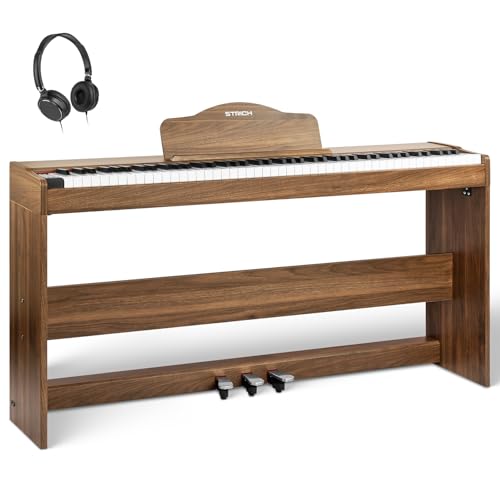
STRICH 88-Key Walnut Hammer Action Digital Piano
Best for: Home players wanting weighted keys and app connectivity
- Special Features
- Built-In Speakers (what this guide is about)
- Number of Keys
- 88
- Key Action
- Fully weighted hammer action
- Preset Tones
- 128
- Connectivity
- USB-MIDI, Wireless, Audio-in
- Speaker System
- 25W x 2
View on Amazon: STRICH 88-Key Walnut Hammer Action Digital Piano Affiliate link
The STRICH SDP-300W is an 88-key digital piano featuring fully weighted hammer action keys with a simulated ivory texture. It includes built-in 25W speakers and an audio-in port for external signal playback. The unit offers 128 polyphony and connects via USB-MIDI and wireless protocols. Its furniture-style design uses a walnut-wood-grain finish. This model suits players seeking a weighted keyboard with integrated audio output and app compatibility.
Pros
- 88 fully weighted hammer action keys with simulated ivory texture
- Built-in 25W speaker system (25W x 2)
- Audio-in port for playing external audio through the piano
- Wireless and USB-MIDI connectivity for app integration
Cons
- No LCD screen for visual feedback or settings
- No built-in sequencer or recording functions listed
- No lighted keys for visual guidance
Good fit if
- You want a weighted keyboard with built-in speakers
- You need wireless connectivity for a teaching app
- You prefer a furniture-style aesthetic with wood grain
Skip if
- You require an LCD screen for navigation
- You need a built-in sequencer for composition
- You want lighted keys for learning
Verdict: The STRICH SDP-300W 88-Key Walnut Digital Piano fits players who prioritize weighted keys and built-in audio over digital features like screens or sequencers. It is a solid choice for home use with app support.

MUSTAR 88-Key Lighted Digital Piano
Best for: Beginners seeking visual key guidance
- Special Features
- Lighted Keys (what this guide is about)
- Number of Keys
- 88
- Key Action
- Semi-weighted
- Form Factor
- Portable
- Preset Tones
- 128
- Pedal Type
- Sustain pedal
View on Amazon: MUSTAR 88-Key Lighted Digital Piano Affiliate link
The MUSTAR U6010404000 features 88 semi-weighted keys with dynamic rainbow LED backlighting. It splits into two 44-key sections for portability, weighing under 10.2 pounds. You get 128 tones and Bluetooth connectivity for lessons. The lighted keys guide finger placement, making it suitable for beginners who want visual feedback during practice.
Pros
- Dynamic rainbow LED keys guide finger placement
- Splits into two 44-key sections for portability
- 128 preset tones and 160 rhythms
- Bluetooth and USB connectivity for lessons
Cons
- Semi-weighted action lacks full hammer resistance
- No built-in sequencer or recording function listed
- Limited to 128 tones compared to higher-end models
Good fit if
- You want visual key guidance for learning
- You need a lightweight, split-able keyboard
- You prefer Bluetooth connectivity for apps
Skip if
- You require fully weighted hammer action
- You need a built-in sequencer for composition
- You prefer traditional non-lighted keys
Verdict: MUSTAR 88-Key Rainbow LED Portable Piano offers unique lighted keys and split functionality for portable learning, but its semi-weighted action and lack of recording features limit it for serious musicians. It fits beginners seeking visual guidance and portability over professional performance specs.

GLARRY 88-Key Heavy Hammer Upright Digital Piano
Best for: beginners wanting LCD screens and upright form
- Special Features
- LCD Screen (what this guide is about)
- Number of Keys
- 88
- Key Action
- Heavy hammer
- Form Factor
- Upright
- Preset Tones
- 800
- Pedal Type
- Triple pedals
View on Amazon: GLARRY 88-Key Heavy Hammer Upright Digital Piano Affiliate link
This GLARRY upright digital piano features 88 heavy hammer keys and a large LCD screen for clear navigation. It includes 800 preset tones, 200 rhythms, and 64-note polyphony. The triple pedal setup and Bluetooth connectivity support versatile practice. It suits beginners seeking a realistic feel and comprehensive learning tools in a stationary format.
Pros
- Large LCD display for easy menu navigation
- 800 preset tones and 200 rhythms
- Triple pedals for realistic piano feel
- Bluetooth and USB-MIDI connectivity
Cons
- Heavy hammer action may feel stiff for advanced players
- Large upright form factor requires significant space
- No mention of app integration or companion software
Good fit if
- You want a stationary piano with a large display
- You need Bluetooth connectivity for practice tools
- You prefer a realistic triple pedal setup
Skip if
- You need a portable or foldable keyboard
- You require a compact footprint for small rooms
- You prefer a lighter, travel-friendly instrument
Verdict: GLARRY 88-Key Upright Digital Piano is a solid choice for beginners who value a large LCD screen and extensive tone library in a stationary upright design.
Specifications side by side
| Spec | Yamaha 88-Key Weighted Portable Digital Piano | The ONE SP-PLAY 88-Key Digital Piano | Donner 88-Key Upright Hammer Action Piano | STRICH 88-Key Walnut Hammer Action Digital Piano | MUSTAR 88-Key Lighted Digital Piano | GLARRY 88-Key Heavy Hammer Upright Digital Piano |
|---|---|---|---|---|---|---|
| Number of Keys | 88 | 88 | 88 | 88 | 88 | 88 |
| Key Action | Weighted | Progressive weighted hammer action | Dual-sensor graded hammer action | Fully weighted hammer action | Semi-weighted | Heavy hammer |
| Form Factor | Portable | not stated | Upright | not stated | Portable | Upright |
| Preset Tones | 10 | 426 | not stated | 128 | 128 | 800 |
| Pedal Type | Sustain foot switch | 3-pedal unit | Triple pedal | not stated | Sustain pedal | Triple pedals |
| Connectivity | USB | USB-MIDI, AUX in/out | Bluetooth MIDI | USB-MIDI, Wireless, Audio-in | USB, MIDI, Bluetooth, headphone jack | Bluetooth, USB-MIDI |
| Speaker System | not stated | Two 20W tweeters, two 25W woofers | not stated | 25W x 2 | not stated | not stated |
| Target Audience | not stated | Beginners | not stated | not stated | Beginners | Beginners |
| Color | Black | White | Bush Cherry Wood Grain | Color Walnut Grain | Multicolor | Matte Black |
| Special Features | Built-In Speakers | Lighted Keys | LCD Screen | Built-In Speakers | Lighted Keys | LCD Screen |
| Dimensions | 52.3 × 11.5 × 6 inches | 54 × 34 × 18 inches | 53.6 × 13 × 31.5 inches | 12.4 × 51.2 × 27.4 inches | 8 × 47.5 × 1.5 inches | 49.8 × 13.4 × 27.1 inches |
| Weight | 25.4 pounds | 121 pounds | not stated | 58.8 pounds | 10.2 pounds | 57.3 pounds |
| Size | 52.25 inches (L) x 11.5 inches (W) x 6 inches (H) | PLAY | 135.8x32.2x77.9 cm | Full | Full | 49.8" x 13.38" x 27.1 |
| Model | P45B | SP-PLAY | DDP | SDP-300W | U6010404000 | GLDP001 |
Frequently asked questions
Do lighted keys replace the need for a teacher?
Lighted keys assist beginners by illuminating specific notes to guide finger placement. This visual aid helps learners memorize note locations quickly without constant instruction. However, it does not replace the need for a teacher to teach rhythm, dynamics, and proper technique. The ONE SP-PLAY and MUSTAR models include this feature for novice players seeking interactive guidance.
Is an LCD screen necessary for playing?
An LCD screen is not necessary for basic playing but is helpful for adjusting settings. It provides clear visibility of parameters like volume, tone selection, and tempo. The Donner DDP-200 and GLARRY upright models feature small displays to help you manage these functions easily. If you prefer simplicity, a model without a screen may be sufficient.
Can I record my playing with a sequencer?
The provided product data does not list sequencer capabilities for any of the featured digital pianos. You cannot record or sequence performances on the Yamaha P45, The ONE SP-PLAY, Donner DDP-200, STRICH SDP-300W, MUSTAR, or GLARRY based on their listed specifications. You would need to use an external recording device or computer software to capture your audio.
How do built-in speakers affect sound quality?
Built-in speakers allow you to hear the instrument directly without external amplification. This simplifies setup for home practice. The ONE SP-PLAY includes a 90W four-speaker array for powerful audio output. The Yamaha P45 and STRICH SDP-300W also feature integrated speakers. Sound quality varies by model, but these systems remove the need for separate audio gear.
Do lighted keys work on all keys?
Lighted keys typically illuminate specific notes to guide your fingers during learning exercises. They do not usually light up every key simultaneously in a random pattern. This feature is designed to help you learn positions and chords. The ONE SP-PLAY and MUSTAR models utilize this technology to assist beginners in navigating the keyboard effectively.
What is the benefit of an upright form factor with an LCD?
An upright form factor provides a stationary, furniture-style design that mimics an acoustic piano. Adding an LCD screen allows you to view settings clearly on the console. The Donner DDP-200 and GLARRY models combine these features. This setup is ideal for home practice where you want a stable instrument with easy access to tone and function adjustments.